SQL ConstantCare® Population Report: Fall 2019
44 Comments
Our SQL ConstantCare® service lets users send data in about their SQL Servers and get health & performance advice via email. Users can opt in to share their anonymized data to get better recommendations overall.
With 3,568 database servers sharing data as of November 28, there’s a lot of useful information in here for the community. Understanding what servers are out there will help you put context around where your own servers rank, and helps the community better build training material that’s relevant for most users. Let’s start with a simple one:
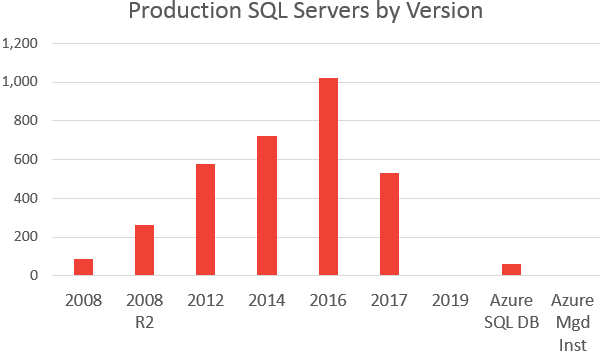
What versions are the most popular?
Or if you’re into percentages:

A few things jump out at me right away:
- SQL Server 2008 has more adoption than Azure SQL DB and Azure Managed Instances combined.
- SQL Server 2019 has only 1 production instance sharing data in the population.
- Almost 50% of the population are already on SQL Server 2016 & 2017. (That’s better than I expected!)
- About 1 in 10 SQL Servers are no longer under support (and don’t even get me started on patching levels.)
Now, I’ll be the first to tell you that SQL ConstantCare® users simply aren’t an accurate representation of the population overall. Quest Spotlight Cloud’s metrics as of 2019/11/28 look a little different: they have 4% of the population on SQL Server 2008, but only 1% of the population on SQL Server 2017. My guess is that that page isn’t kept up to date.
I’m looking forward to trending this data over time to see the rate at which people adopt newer versions of SQL Server. I’m going to publish these quarterly. In the next couple/few, I’ll stick with this same presentation format, but once we’ve got some timeline-friendly data, I’ll look at more interesting ways to present it.
I’m not sure if people who use SQL ConstantCare® are more or less likely to jump to newer versions faster. I’d like to think that you, dear reader, are more likely to be on the cutting edge. However, I might have a couple of different kinds of readers: one conservative group that likes mainstream versions and monitoring tools, and another group that likes cutting edge stuff and doesn’t want SQL ConstantCare®.
But what about development? Are people maybe testing their apps on newer versions?
What versions are people using in development?
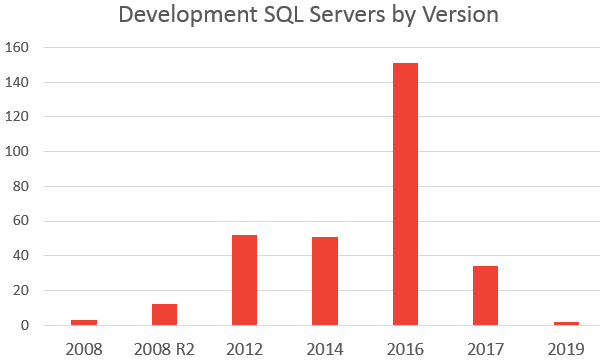
It’s interesting how different this mix is than the last chart! 50% of all Development Edition servers are running SQL Server 2016, and 11% are on 2017.
Twice as many people are using SQL Server 2019 in development as there are in production. (I’ll leave the math to you, dear reader.)
For the rest of the census report, I’m going to focus on just the production servers.
How much data do servers have?
I think this chart really helps to set the rest of them in perspective:
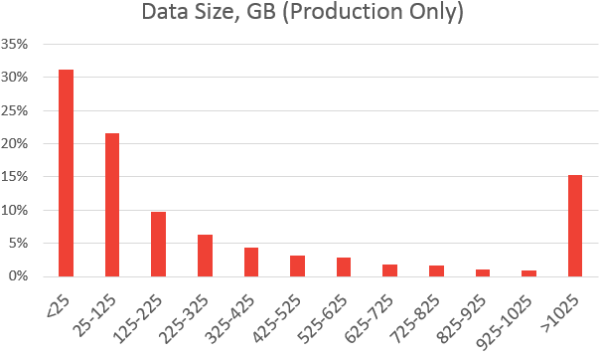
A lot of the SQL ConstantCare® population have what I would consider to be a fairly small server: 30% of them are hosting <25 GB data.
About 15% have 1TB of data or more, but even though that number sounds low, the population is still large. That still gives us about 500 servers’ worth of metadata to help guide folks who are in those larger tiers. There are a dozen instances in the population with over 10TB – good times there.
How much hardware do production servers get?
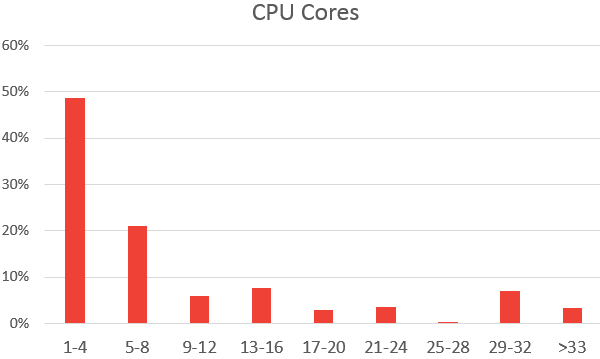
This really helps to reset folks’ expectations around what’s normal for SQL Servers out there. There are a huge, huge amount of production SQL Servers that just don’t need a lot of CPU power. Almost 70% have 1-8 cores, while only 10% of servers have more than 24 CPU cores.

Given that almost 50% of the population have 1-4 cores, that isn’t too surprising. But what if we exclude the folks using 1-4 cores?
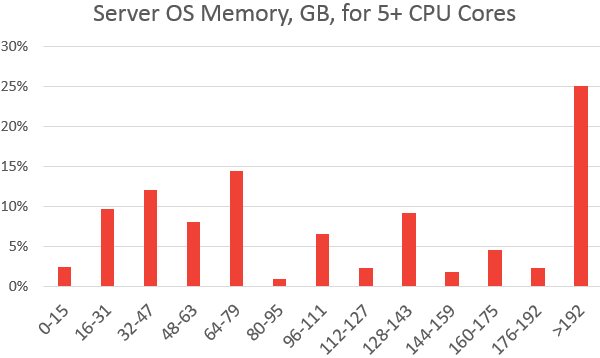
Okay, now that’s much more like it: 68% of that population is using 64GB of RAM or more. Good to see folks investing in the resource that has an amazing impact on performance, especially given the SQL Server licensing costs involved.
What questions would you ask the data?
If there’s something you’d like to see analyzed, leave a note in the comments. To make it more likely that I’ll actually run your experiment, include why you want to know it, and even better, your guess as to what the data’s going to say. (That’ll make it a more fun game to play, heh.) I’ll take my favorites and do a followup post with those answers.