Blog

Pop quiz: should you be worried if your SQL Server’s page life expectancy is averaging 214? There’s only one correct answer: it depends.

Performance tuning is all about finding the RIGHT bottleneck, focusing on it, and fixing it to the application owner’s satisfaction. Learn what happens if you don’t do it right.

Bottlenecks and Bank Balances

6 Comments

Pop quiz: should you be worried if your SQL Server’s page life expectancy is averaging 214?

There’s only one correct answer: it depends.  Successful performance tuning boils down to a simple cycle:

  • Measure the application’s performance
  • Find the current bottleneck
  • Improve that bottleneck so that it’s not the bottleneck anymore
  • Measure to find out how much your application performance improved
  • Ask the application owner if it’s good enough now. If so, move on to the next application. If not, go back to step 2.

And every one of those steps is equally important.

If You Don’t Find the Right Bottleneck

The Bottleneck Is Plenty Big Enough for You
This Bottleneck Is Plenty Big Enough for You

Performance tuning isn’t about zooming in and focusing on a single number in incredible detail; rather, it’s about stepping away and getting the full picture. Time and again, I get emails asking about whether a single metric is OK, but upon questioning, the DBA has leapt to a conclusion without surveying the environment as a whole. If you spend your tuning time closely examining a single metric, trying to figure out how to improve that one metric, you might not improve the performance of your application.

Sure, your page life expectancy might be pretty bad – but is that the one thing keeping your application from performing faster?

Take a step back and gather a complete set of Perfmon metrics. Look at CPU, memory, disk, and network performance as a whole. Find the thing that’s in the absolute worst shape possible. In that link, I explain the order that I look at metrics to find which one looks like the most likely bottleneck.

If You Don’t Focus on Improving the Bottleneck

I was recently working with a client frustrated with their application performance. I found two issues:

  • CPU-intensive user-defined functions were being called thousands of times per query
  • The storage subsystem was nowhere near as fast in practice as the vendor had claimed

The application’s bottleneck was the CPU-intensive UDFs. The server was frequently pegged at 100% CPU, and queries just couldn’t run any faster until they were rewritten to rip out the UDFs. I put together a recommended plan of action to take those UDFs out, which would make the application an order of magnitude faster. I noted that they should probably start working on the storage performance in a second track, because the instant the UDFs were removed, storage was going to become a problem. With the CPU-burning UDFs out of the way, the server would be able to churn through more records faster, but the storage subsystem wouldn’t be able to deliver records fast enough to satisfy the users.

On our next status update call, they said they’d reworked the storage subsystem. SQLIO reported dramatically faster storage throughput, but they were only seeing a minor improvement in application performance. I had to break the bad news to them that they’d focused on the wrong problem first. After we revisited my report together, they pursued the UDFs with renewed vigor, and suddenly the application was blazing fast. Thankfully I’d documented my findings in writing, but if I’d have been an internal employee, I might have communicated that in verbal form instead. I might have lost the ensuing battle to fix the UDFs because the manager would have thought my advice was bogus.

If You Don’t Measure Your Improvements

You Get What You Measure

All DBAs are consultants.

Some of us think we’re full time company employees, but in reality, we’re delivering a service. Whether they’re developers, project managers, end users, or other DBAs, they’re looking at you just as if you were an outsider. You’re expected to stride in, identify the problem, mitigate it, and show that your work delivered a return on investment. The investment, in case you’re not following, is your paycheck.

Don’t believe me? Poke around in an application and then throw up your hands, saying you can’t find a way to make it go faster. The next phone call the project manager makes will be to an external consultant, and the project manager probably won’t call you first next time. (Sometimes, that’s not a bad thing.)

If you put in a lot of hard work to make an application go faster, but you don’t measure the before-and-after effects of your work, someone else is going to take credit. The developers will say the improvements were due to a new version of their code, because they’re working on the code at the same time you’re working on the database. The sysadmins will say they defragged the muffler bearings. The SAN guy will say he tweaked the flux capacitor. The project manager will say he made everybody worked long hours and that did the trick. The only way, the ONLY way that the DBA can ever take credit is to take clear before-and-after measurements for proof. Run the same code base before & after your tweaks, and measure application performance. Follow up with a written report, even if it’s a one-paragraph email, summing up your changes and the performance improvements, and copy your manager on it.

If You Don’t Ask the App Owner If It’s Good Enough

Never confuse what YOU think about a metric with what the BUSINESS thinks about a metric. Your CEO doesn’t care about page life expectancy. (Your CEO probably doesn’t even care about the DBA’s life expectancy.) Before you spend time or money improving an application, you have to find out whether it’s the most important thing to your business right now.

Say hello to the most important metric you will ever calculate: opportunity cost.

A Long Night at Zig Zag Has Its Own Opportunity Cost

Opportunity cost is the cost of doing something as compared to the cost of doing something else. If you spend eight hours today improving the page life expectancy of a particular server, is that worth more to the business than anything else you could be doing in those eight hours? Could you spend eight hours doing something more valuable?

I use opportunity cost whenever anyone asks me to do something.

As an employee, if a project manager asks me to tune a particular application, I bring them into my manager’s office and say, “It will take me three days to make that application faster. I’ll probably make it an order of magnitude faster, because I’ve never tuned that server before. However, if I take those three days to do it, I won’t make the deadline for Project Snazzywidget. Which one is worth more to you?” At that point, it’s a political decision and a business decision, not a technical decision. If you’re doing the best job of any employee he has, your manager will put you on the most valuable project – which in turn increases your worth again.

As a consultant, I approach the problem differently: “Here’s the thing – I could spend another three days working on this application, but from this point forward, I’m only going to be able to achieve incremental improvements, not the order-of-magnitude improvements we saw in the first few rounds of tuning. I hate to make you guys go through that for a small gain – but is there another application in-house that isn’t delivering the performance you want?” This resets the client’s expectations, and they start seeing you as a weapon that they can point at slow applications. They’ll cherish your time and focus you where your effort will pay off the most. This keeps your perceived ROI high. If you deliver jawdropping results each time you tune an application, you can justify higher billable rates.

After all – isn’t your bank balance the one metric you really want to improve?


Travel Tips for Non-Frequent Flyers

21 Comments

If you’re traveling to one of the upcoming fall conferences, here’s a few of my favorite travel tips – as inspired by Kevin Kline’s recent travel tips post.  (If some of these familiar, it’s because I originally ran parts of it last fall before the conference season.)

Use SeatGuru.com or SeatExpert.com to get the best seat.

I’m not talking about first class versus coach – even in coach, not all seats are created equal.  Every plane has some surprise seats that have more room or awkward armrest setups.

SeatGuru and SeatExpert have maps of every plane flown by every airline.  Call your airline or check online to find out the exact make & model of plane you’re flying and then pull up the SeatGuru or SeatExpert map.  The seats are color-coded by comfort level.  Hover your mouse over your seat, and you’ll see detailed notes about the comfort level of that particular seat.  Then, with that map up on your screen, call your travel agent or go to your airline’s web site to change your seat.  You can sometimes do this online even when it’s too early to check in for your flight, and the earlier you do this, the better your chances are for getting a good seat.

I’m typing this from the comfort of a Continental Embraer RJ-135, seat 12A.  It’s an exit row seat with no seat on either side of me, so I have plenty of space in front of me for my legs, and plenty of space on either side for my arms.  It didn’t cost me any extra – I just went to Continental.com and tweaked the seat on my reservation.

For long flights, I recommend the aisle seats because it’s easier to get up and go to the bathroom and the bar.  What?  You didn’t know about the bar?  Anytime you’re thirsty, just head to the flight attendant area, and they’ve usually got water, soda, and snacks available for self-service customers.  If you’re right-handed, get the aisle seat on the left side of the plane so that you’ve got room to maneuver; I find it easier to type, move the touchpad around, and so on when I’ve got room for my right elbow.

If you don’t find a better seat, don’t give up: check again exactly 3 days and 2 days before departure.  Airlines automatically upgrade their elite frequent fliers to first class for free at those times, and guess what – that means their seats in coach are suddenly empty.  These people are exactly the kinds of people who usually know to grab exit row seats and those “special” seats with more room, so you’ll find these seats opening up again.

No assigned seat?  Check in online ASAP.

If your airline reservation doesn’t show an exact seat number, your flight may be overbooked.  Airlines routinely overbook flights because not everybody shows up for a flight.

Go to your airline’s web site and try to check in right now.  You won’t be able to, but it will tell you when the flight checkin will open up.  Set yourself a reminder to check in at that date/time.  The earlier you check in, the more likely that you’ll get an assigned seat.  The later you check in – well, let’s just say you don’t want to get a miserable $100 air travel voucher in exchange for missing the first day of PASS.

Knock yourself out on long flights.

Drool Not Shown
Drool Not Shown

Forget paying extra for a first class upgrade.  Get a travel pillow for under $10.  The one shown here is an inflatable model, which is nice because you can deflate it and stick it in a laptop bag.  If you don’t want to carry one around, you can usually pick up the non-inflatable ones in airport gift shops for around $20.

Now, I know what you’re thinking – you’re thinking that wearing an inflatable toilet seat around your neck will make you look stupid.  You’re wrong.  The drool coming out of your mouth is what’s going to make you look stupid.

As you’re boarding, take a sleeping pill.  Settle into your seat.  If you want a blanket, buckle your seatbelt on the outside of your blanket so that the flight attendant won’t have to wake you up to make sure you’re wearing it.  You’ll be out like a light in no time.

Conquer time zone changes with vitamin B12.

This tip comes from Douglas McDowell of SolidQ, and it’s saved my bacon more than a few times now.  Pick up some vitamin B12 pills at your local drugstore and keep ’em in your laptop bag.  I prefer blister-packed sublingual pills – the sublingual ones that come in a bottle break up pretty quickly if they bang around.  Take one, and you’ll be comfortably awake for a couple of hours, but not wired or jittery.

Caffeine is the wrong answer – it dehydrates you, makes you jittery, and has other side effects that you want to avoid when traveling.

Be wary of taking late flights for travel vouchers.

Those travel vouchers sometimes have blackout dates, and the blackout dates are like “Valid only for trips with a Saturday stay on the third week of the month.”  If you really want to risk it, then talk to the airline staff before you volunteer the seat.  Ask whether the voucher has any restrictions at all, and ask them to show you one of the vouchers.  If it says anything about “Only valid for fare code X”, there’s a catch.

Oh, and whether you’re delayed by weather or you take a late flight by choice, call your hotel to let them know.  If you don’t show up by midnight, they have a tendency to give away your room to somebody else when they’re booked solid.  Don’t expect to be able to waltz in the next day thinking your room will still be held for you.  If you don’t show up on the day of your reservation, they might charge you for one night’s stay, but they won’t hold the room for your entire stay.

Leave a tip for the hotel maid on your pillow.

The Wrong Kind of Rock Star Behavior

Hotel maids make minimum wage, and it’s common to leave them tips.  Some folks only leave the tip on the day of checkout, but I prefer to leave a tip daily because the same maid may not clean your room the entire time – they do get days off, ya know.

Also, make it as easy as possible for the maid.  Use just one trash can if you can, and dump your used towels in a single pile on the toilet seat (with the seat closed, speedy).  It’s less bending over for them.

Plan questions for vendors and peers.

Ahead of time, make a list of projects you’re working on, new products you want to implement, or large challenges that you’re facing.  Write this stuff down now, because you won’t remember it when somebody asks, “Do you have any questions?”  Us humans are terrible at that.

This is just my personal opinion, but I say do NOT ask tech support questions at a conference.  Tech support people aren’t usually the ones sent to conferences.  If you want support, call the support line.  If you have large architecture questions, implementation ideas, or tips and tricks, then you’ll find good answers at a conference.  If you’re getting error 0x8004005,search the web.

Make a list of things to bring to the conference.

Here’s a list of things you may not think to bring along:

  • A small, light extension cord or surge strip. There’s never enough outlets, especially at tech conferences.  If your laptop has a two-prong electric adapter, bring a two-prong extension cord too, because not all outlets have three prongs.  A 2-prong extension cord will get you into places other people can’t go.
  • An extra laptop battery. It ain’t cheap, but if you want to take notes during the sessions, it’s easier if you don’t have to fight over power outlets.
  • Business cards. If you have a personal web site you want to promote, or if you use Twitter, order business cards now.  They’re surprisingly inexpensive if you’re doing simple text with no logos – like $10 for 250-500.  I order a set just for conferences that have conference-relevant information like my work email, personal email, Twitter link, web site links, etc, but not mailing address.  (Nobody at a conference wants your snail mail address, although you can put city & state if you want an icebreaker.)  For ultra-personal cards, check out Moo.com.

Don’t feel guilty about skipping sessions to mingle.

I make a list of sessions that I absolutely can’t miss, but the rest of the time, I wing it.  If I get the chance to have a one-on-one impromptu chat session with somebody really brilliant, I’ll go for that, because frankly, that’s worth way more than a session.

For example, I got the chance last year to sit in the hallway during a session and do some impromptu data mining with Donald Farmer, and that’s one of my favorite memories from the Summit.  Did I miss a session?  Yep.  Did I feel guilty?  Only for about the first five minutes.

Leave the support calls at home, or bring your evidence.

PASS is a great place to get access to some of the brightest minds in the database business.

It’s a really crappy place to open a support case.

If you’re struggling with a problem that you just can’t fix, and you’ve opened a support case with Microsoft (or in my case, Quest), it can be tempting to approach Microsoft employees and ask for insight.  You know how when the doctor bangs your knee, your leg jerks up?  I have a really similar reaction.  When someone says they’re having a problem, I blurt out, “I need your Windows event logs – both system and application – plus the results from sp_configure and dbcc tracestatus.”

If you’re going to ask support questions, be fair – bring along your support case number, a folder with all of the evidence you’ve gathered so far in the case, and a laptop that can access the system remotely right now.  Armed with that, you stand a great chance of getting great minds to ponder your problem and cooperate with you pronto.  Without that, you’re probably going to get a polite smile-and-nod-I-feel-your-pain.

Never eat or drink alone – tweet with #SQLPass.

If you’re going to an upcoming conference, bookmark these two links now on your phone or your PDA:

During the conference, I’ll tweet whenever I find out about after-hours events, dinners, meetups, or spontaneous meetings during the day.

I remember what it was like going to PASS 2007 as an attendee who didn’t know anybody – man, it was tough to find out what was going on!  I ate lunch and dinner by myself most of the time.  Let’s face it, us DBAs aren’t always the best party people.  (Except for the PASSCamp Germany guys, they know how to put on a party!)  Now that I’m an insider (woohoo!) I’ll share the knowledge to get you folks into the action.

A lot of us will be roaming around downtown Seattle with our handheld gadgets, monitoring the Twittersphere for the phrase #SQLPASS in much the same way that truckers use their CB radios to monitor channel 19 looking for bears.  When you’re bored, get on Twitter and say so, but make sure to include the phrase #SQLPass.  Someone will hear your pain and tell you where the party’s at.


#SQLBingo: Meet nice people and learn their safewords.

9 Comments

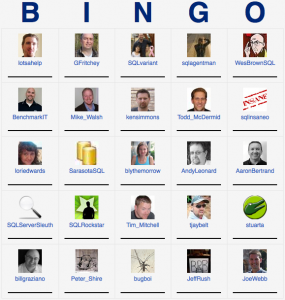
Stuart Ainsworth (BlogTwitter) had a killer idea: what if we had a Twitter bingo at the PASS Summit?  We could print cards ahead of time, and attendees would run around the Summit trying to meet the celebritweeps.  Next thing you know, #SQLBingo was born.  Here’s how it works:

BINGO!
BINGO!

Step 1: Before you go to Seattle, print out 3 #SQLBingo cards.

Go to http://sqlserverpedia.com/bingo and print the page three times.  If you don’t like the Twitter folks pictured on your card, just hit refresh, and you’ll be greeted with another random group chosen from folks who volunteered on Stuart’s blog.

If you forget your #SQLBingo cards, you can pick up a set at the PASS booth.

Step 2: Look for your tweeps and line ’em up.

Search out “The Squares,” as we call ’em, as you wander around the Summit.  Each Square has a private code word.  Ask for their code word, and write it down in their #SQLBingo card space.

Just like normal bingo, you need a different pattern each day:

  • Tuesday – straight line in any direction (all 5 squares)
  • Wednesday – two straight lines in any direction (9 or 10 squares)
  • Thursday – blackout (all squares covered)

To make it easier, code words don’t change each day, so when you get someone’s code word you should fill it in on all 3 of your cards.  They don’t have to sign your card – just fill in the code word.

Step 3: Each day, turn in your card.

When you’ve got the right pattern, deposit your card in the PASS booth.  Each evening, we’ll draw winners for prizes like $50 gift cards and a free pair of bingo wings.  Winners will be notified by email, so get your name & email right on the bottom of your bingo card.

You don’t have to be on Twitter to win, but it might help.  If you’re wondering where to find these people, you can search Twitter for #SQLbingo.  The Squares are encouraged to randomly tweet their location with the #SQLBingo tag, which will make it easier for everyone else to track ’em down.

In my PASS sessions, at the Quest breakfast session on Wednesday, and at the Virtualization Virtual Chapter breakfast on Thursday morning, I’ll ask all of the Squares in attendance to stand up, thereby making it even easier for you to throw things at them get their safe word get their code word.

That’s the part I’m most excited about – hearing everybody’s choice of code word!  I’ve already heard a couple of hilarious ones.


StackOverflow #DevDays San Francisco Recap

7 Comments

I didn’t know what to expect from StackOverflow DevDays, and I was pleasantly surprised.

In a nutshell, the presenters showed the basics of several different programming environments, but it was anything other than “Language X 101.”  This was top-gun coders showing the pros and cons of their particular language, taking very sharp questions from very sharp audience members, and being frankly honest about the things you need to know before you start programming with it.

Some of the sessions included:

  • Mark Harrison on Python – showed off a one-page Python spellchecker with “did-you-mean” style autocorrection
  • Rory Blyth on iPhone development – showed the rather intimidating side of the development IDE
  • Scott Hanselman on ASP.NET MVC – showed how Visual Studio 2010 is catching up with other MVC implementations
  • Daniel Rocha on Nokia’s Qt – showed that yes, cross-platform apps are still vying for Miss Congeniality
  • James Yum on Android – showed why building properly threaded applications can still be rocket science

My first reaction was that I’m really glad I’m not a developer anymore.  Database administration seems a lot easier to me than some of this development work.  After building your Android app, for example, you have to test it against all kinds of different screen resolutions, screen densities, portrait vs landscape, etc – oh, and by the way, if you flip between portrait and landscape, Android may just restart your app.  Y’know, to be safe.  Wow.  Suddenly, $.99 for phone apps sounds even cheaper, and I’m even more impressed with apps like Layar.

The presentations are still rapidly evolving based on attendee feedback.  Some of the presenters mentioned that they’d radically revised their presentation level (beginner vs expert) after feedback from earlier #DevDays events, so your mileage may vary.

Microsoft threw in a surprise: they sent someone with boxloads of 2 gig laptop memory chips and a screwdriver kit.  Anybody whose laptop wasn’t already maxed out with memory could swing by Microsoft’s table and get it upgraded – free.  Now that’s my kind of schwag.  (As it happens, mine was already maxed out.)  There were several jabs suggesting they were doing it as a pre-emptive strike because Visual Studio 2010 must be some kind of memory pig, but it was all in good fun.

I’d recommend DevDays to programmers at any level.  If nothing else, you’ll see that the grass isn’t any greener for programmers of other languages.

Best of all, I finally got to meet the StackOverflow crew in person – Jeff Atwood (BlogTwitter), Geoff Dalgas (BlogTwitter), and Jarrod Dixon (Twitter), good guys all.  (I’m just now realizing I didn’t track down Joel, although I did meet Babak.)


PASS Session Preview: Yes, I’m Actually Using the Cloud

#SQLPass
0

In this session at the PASS Summit in Seattle, I’ll talk about the options for SQL Server in the cloud today and how I’m using them for my projects.  I’ll talk about how to choose the right cloud-based solution for your needs, and I’ll do a live demo of working with SQL Server in the cloud.

Here’s a video preview of me walking through the first several slides in the deck:

[media id=23 width=640 height=500]

I’ll be giving this session on Thursday, November 5th at 1:00pm – 2:15pm in room 201.  This is the smallest capacity room at the summit, fitting only 128 people as opposed to 300-500, and I got a huge laugh out of that.  Tells you something about the demand for SQL Server in the cloud knowledge or my presentation skills – or both!

Update: SearchSQLServer.com published an interview with me about using SQL Server in the cloud.


Update on the PASS Board Elections

#SQLPass
0

I don’t reread blog posts after I’ve read ’em once.  If there weren’t comments when I first read the blog post, I’m not likely to go back to check later to find out what’s going on.

However, I published one post recently that you might want to reread.  I interviewed Matt Morollo about why he’s running for the PASS Board of Directors, and over a couple of days, comments really piled up.  Matt did a fantastic job of staying engaged with the other commenters, leaving a lot of responses to address questions and concerns.

If you haven’t voted yet, take the time to read through the comments before you vote.


Microsoft SQL Azure: The Flat Pack Database

Microsoft Azure
8 Comments

Last weekend, Erika and I stumbled across a coffee table at Ikea that we liked much more than we’d expect for a $50 table.

The Finished Product

Erika has champagne tastes; she can walk into any store and find the highest-priced item without ever seeing the price tags.  She’s just drawn to expensive stuff.  She’s had her eye on a $1,000 marble-top cocktail table (they’re not called coffee tables anymore, don’t ya know) from Room & Board for months.  Therefore, it was a complete shock when we both really liked this $50 table with exactly the same lines and shape, but a simple white veneer top instead of marble.

$950 savings?  Sold.

Granted, we won’t be passing this table down to our grandchildren, but we don’t even plan on having kids, let alone grandkids.  And this table might not last ten years, but at $50 a pop, we could buy a new one every five years for 100 years straight.  Odds are, our tastes will change over the course of the next 100 years, too.

The catch with Ikea is that the stuff is flat packed – the table comes in a flat box.  You’re responsible for hauling it through the aisles of the store, getting it home in your car, and assembling it yourself.  I’ve done this enough over the years that it doesn’t stress me out (anymore).  My tips for a successful Ikea build are:

  • Read the instructions three times – which is pretty simple, since they’re pictures, not words
  • Use an electric screwdriver to avoid exertion
  • Drink your favorite alcoholic beverage in moderation during assembly
  • Whenever you’re about to curse, stop to think about how much money you saved
  • When you’re done, don’t stand on it to test it

All of those are equally important.

If you don’t read and reread the directions, it’s very easy to end up with a desk that shakes when you type on it – and I happen to be typing on one of those at this very moment.  If you don’t use an electric screwdriver, your arms will be tired before you get halfway through, and you’ll strip out the screw heads.  If you don’t drink, you won’t be mellow enough to laugh at the pictures in the directions.  If you don’t constantly remind yourself of how much money you saved, you’ll be picking up the phone to call Crate & Barrel.

And finally, unless you bought a piece of furniture that was specifically designed for you to stand on, then it wasn’t.  Don’t stand on it to prove a point, because more often than not, you’ll prove that it wasn’t designed with standing in mind.

Ikea Table - Before
Ikea Table - Before

SQL Server is the Marble Coffee Table

When you’re building a brand-new product, company, or web site on the Microsoft stack, SQL Server Enterprise Edition is the sexy marble-top cocktail table.  That’s the one you really want, baby.  You just know all your friends will ooh and aah when you bring ’em over for the opening night party and say, “Yeah, I built it with SQL Server.”

“But it’s so expensive!” they’ll say.

“Yeah, but my app is worth it.  SQL Server Enterprise Edition scales like there’s no tomorrow.  Built-in backup compression, partitioning, database mirroring, active/active clustering, and all that stuff those MySQL guys can only dream about.  We’re ready for the future now, baby.  Want another glass of champagne?  My venture capital guy bought us a couple dozen cases of the good stuff.”

Riiight.  Back to reality.

SQL Azure is the Flat Pack Database

Much like Ikea furniture, Microsoft SQL Azure is a cheap way to get a reasonable facsimile of the database you really want, but can’t justify buying.

There’s drawbacks:

  • Backups are not included – if you want to get your data out, get out your electric screwdriver and build it yourself
  • Scaling is not included – you have to roll your own sharding, and frankly, I don’t know anybody who does a good job of that
  • Database mirroring, partitioning, clustering, and batteries are not included
  • You can’t stand on it – don’t use this for your data warehouse or high-throughput databases, because the data goes through your internet connection

But if you can live with those drawbacks and build your own HA/DR solution – just like you dragged home your Ikea coffee table and assembled it yourself – you can save a lot of money.

Both SQL Server and Azure can – and will – coexist.  Heck, Ikea furniture happily coexists with the good stuff in my house too.  Now, if you’ll excuse me, I’ll go refresh the Crate & Barrel web site to see when my dining room table and chaise lounge are going to arrive.


Bad News, Good News, Worse News

7 Comments

Ran across a funny situation in my test lab, and it’s only funny because it was my test lab.

The bad news: backups started failing a few days ago. One of the databases had a filegroup that wasn’t online, and as my maintenance plan looped through the list of databases, it died when it couldn’t back up that database.  Unfortunately, it was going in alphabetical order, and that database started with a B.

Jesus Saves - and he always uses the shared drive.

The good news: the separate cleanup jobs still worked great. They were dutifully cleaning out any backups older than a few days.

The worst news: database mail had failed – of course, a few days before the backups started failing.  My DNS servers in my lab had decided to take the week off, so email wasn’t making it out of my lab.  I didn’t get notified about the backup jobs that started to fail.

The cleanup jobs worked better than the backup jobs, and the right hand didn’t know what the left hand was doing.  In this particular case, the left hand had been amputated at the wrist.  In a perfect world – or at least, in a world where my job depended on this data – the maintenance plan jobs would be interconnected so that they wouldn’t delete backup files if the backup job failed.  That perfect world would not be my server lab.

No real data was harmed in the making of this blog post, but times like this remind me of just how hard it is to be a good database administrator, and how easy it is to lose data.  Have you tested your restores lately?  Do you really think you’ve got something more important to do?


Meet PASS Board Candidate Matt Morollo

#SQLPass
192 Comments

The PASS Board of Directors election starts on October 12th, and we’ve got four really well-qualified candidates to choose from:

You can read their bios at the PASS Candidate List, and they’re good, but I wanted more. I emailed each of them with a set of interview questions to satisfy my bizarre curiosity. Today’s response comes from Matt Morollo:

Brent: First, thanks for volunteering to dedicate your time to the community. What made you decide to run for the Board of Directors this year?

SQL PASS represents the type of Media organization that matches the type of vendor which aligns with my ideals of a highly reputable B2B Media porvider; one that would be a thrill to be a part of. Over the last 14 years my career has been committed to providing IT and App Dev professionals best-of-breed Media with integrity and enthusiasm.   As a veteran Media professional that has built successful contemporary IT focused B2B businesses, my hope is to add value to the future strategy of PASS and also come away with some great experience and new professional acquaintances – people that share my passion for this work.   PASS is a Media organization first and foremost and needs the next generation of Media professionals at the table to navigate through this very unique time in business Media.   My aspirations match their goals and objectives, and few are as uniquely qualified in Media; this is what I do and have done all my career.

Walk us through one of your typical workdays. What do you do?

The Media business is extremely deadline oriented, dynamic, and very competitive.   As many Media vendors, 1105 Media works in a virtual environment (7 offices in 10 states plus a large number of home office employees) so communication is critical to what we do each and every day; it is well orchestrated, disciplined, and highly complex.  Keeping up my meeting and publishing schedules is what my day initially revolves around.   When not traveling, my time is spent strategizing with sales, marketing, editorial, working on operational issues, meeting clients, developing partnerships, closing issues, forecasting, and working toward our revenue objectives.   All this requires a lot of teamwork/meetings and working through day-to-day challenges as they surface.  Organization and prioritization is critical in Media.

What parts of your day-to-day experience will make you a better Board of Directors candidate than the other candidates?

If this has not been stressed already; PASS is a Media organization serving a very influential community of SQL oriented professionals.  Nothing is more important than serving the audience/community and content environments with the right information and asset types.   My job is largely about keeping our business relevant and navigating through the murky waters of modern Media so the business is able to continue to sustain profitability and growth (my parent company, the Redmond Media Group now includes MSDN and TechNet in addition to all the Redmond branded assets in print, online plus Face-to-Face events and Virtual Conferences/Expos). Again, as someone with a track record of success, and someone who has been part of a team that has built Redmond Media Group, the most successful Media organization serving Microsoft- oriented IT and App Dev communities, no other candidate matches the experience required as the PASS BOD has outline to me.

I’ve heard that the PASS Board of Directors is a time-consuming hobby to say the least, and at this point in our careers, none of us have tons of extra time. What other projects or things do you expect to have to cut back in order to make time for the Board? (I’d just like to give the readers an idea of how tough it is to prioritize things.)

Having spent the last 14 years strapped to a PC, speaking with audiences, advertising partners, and traveling on airplanes, you cannot be successful in Media without a strong work ethic, and more importantly a passion for this business.   I’m not saying being a SQL Administrator is not a hard job, but the Media business is a much different occupation – in fact given the complexity and competitive nature of the business, there is a high attrition rate and very few people and companies have had the kind of success that 1105 Media continues to have (just last week Questex and recently Cygnus filed Chapter 11 for example – B2B Media woes are in the news daily – its no secret).   PASS can expect that kind of work ethic and enthusiasm from me.  This business excites me and I’ve always been able to ensure the business strives and is successful through good times and bad (my personal sense is this is one of the best times as change is the most constant variable in Media and now is the time to build off that momentum).   The reason why the BOD position is such a strong match is because hard work is what makes a Media business successful, and with a passion for serving Microsoft-oriented professionals, making time is something that the BOD can expect and is something that was expected upon my initial application.

I believe social networking and Web 2.0 tools like Twitter, Facebook, and StackOverflow are changing the way DBAs interact with each other, get training, and solve problems. Do you agree or disagree, and why?

(No answer)

Do you blog and use social networking tools? Where can DBAs find you online?

Yes: LinkedIn, Twitter, and Facebook.   I am also a member of the Internet Advertising Bureau’s Executive Council on Sales and that community puts out a lot of community based information via SmartBrief.  Social Networking represent great marketing assets in my opinion.  They are also great tools for communicating, and guiding participating communities to key areas of the web.   For Media organizations specifically, they help keep the community up to date with information they might not otherwise find as well as sharing ideas and other information resources.   Again, as a BOD member, any DBA can certainly reach me, but my role would be mostly transparent to them; the PASS board is not a platform for me (that is a key distinction as a candidate) to be a key figure in the community of SQL professionals, but rather a role where it is possible for me to ensure the PASS community gets the best information assets in the market.   The goal is to help guide the PASS strategy and make it the most relevant Media vendor and community for SQL professionals.   Just as a publisher, the audiences don’t know me, our editors on the other hand they are intimately familiar with.  They are out there in the “mosh pit” mixing with audiences.  The role of a business professional in Media like myself, is to put the best content makers on a pedestal, keep them visible and available to the core community and audiences served.

Do you have any conflicts of interest that may pose a challenge?

None; the opportunity dovetails with my ambitions, aspirations, and more importantly my ability.  My track record demonstrates this as do my prior statements.

If PASS put you in charge of increasing new memberships, what specific steps would you take?

New membership is critical to all Media organizations; maintaining a qualified membership community and providing best-of-breed content are essentially, or to net down, one the core objectives of any company in the business of niche B2B Media.    As a publisher who has spent years and years building communities, I’m familiar with all models including qualified, paid, SEO/M, social networking, alliances, and contemporary Audience Development (AD) practices.   There is no silver bullet here and there are a number of methods in order to accomplish this key objective.  I can’t sit here and tell you what exactly I can do; no one can unless they are familiar with the resources and budgets that PASS has.   What I can tell you, is that I will, and am extremely qualified in the practice of Audience Development and that PASS can expect that my skills will be applied along with my experience to the best of my ability.  The best and most modern AD practices will be applied with creativity and enthusiasm.  My experience also involves global expansion and my understanding is that is a core PASS objective (my BA from GWU in International Communications is also relevant).

What do you think PASS is doing right to improve the day-to-day lives of database administrators?

This BOD work is a great example.   The team is looking for the best from  a strategic business perspective.   What I can tell you, is that each nominee, unless they have a decade plus experience in building, growing, and leading B2B organizations has really has no idea what kind of challenges and how hard the work is involved in growing a Media organization like PASS.   Everyone I’ve seen on the ballot may make a great speaker, writer, or be a world-class SQL DBA, but aren’t experienced in the business of Media to the extent that I am.   With respect to all of the nominees, they are highly skilled SQL technicians.  That’s great, but PASS is Media company serving communities with information resources that keep them captive  In my opinion, based on what I know, the PASS BOD needs a MEDIA PROFESSIONAL experienced with Microsoft and IT publishing/events.  The reason PASS appeals to me, and to answer the question more directly, is that PASS has a strong reputation as a provider of best-of-breed information assets with integrity, and has access to the most innovative community of SQL based content providers.   The challenge is the web has  opened up a whole new set of opportunities for communities to find information.  The Redmond Media Group for example references SQL and supports every key vendor in this market, employs some of the best contributors who produce articles, white papers, webcasts, speak at our events on the subject, but it is much broader and focused on providing information to the MCP, Developer, IT, & Partner communities across all Microsoft disciplines.   Again, let me stress that PASS is in an extremely competitive marketplace, needs to remain relevant as a key information provider, and has to work on building the communities in the midst of a highly competitive and complex environment.  PASS has two key competitive advantages; a) the organization is recognized globally as the most targeted and credible community reaching top SQL Professionals b) SQL is poised to grow as the information boom continues to accelerate at a pace that is almost impossible to describe; SQL is, and will remain fundamental to the data revolution.   This excites me and is why I’m so keen to be a part of PASS.

What do you think PASS could do better, and how?

This is a question for the community and one that is mission-critical as PASS evolves and grows as an organization.  B2B Media organizations rely on the communities they serve to provide this kind of feedback on a regular basis via show evaluation forms, surveys, and other research.   Dialogue is also important and to borrow a phrase, the community and vendor partners must be treated “like family”.   They are vital in providing this kind of information and shaping the organization.   The first thing I’d hope to do as a Board member, is to dive into the community surveys, research, and other data (even if its verbatim) and  speak with key members in person (via email, phone, in person at local chapters).  Knowing and listening to the community is the most important thing the Board and team at PASS can engage in.  The community represents the future, and the work that needs to be done revolves around them.   Finally, to borrow another phrase in Media “content is king”.  As long as PASS remains committed to providing the best and most relevant content, PASS will continue to be successful and have the communities” attention.

Sum up your goals for PASS in 140 characters or less:

Understand key objectives, challenges, and work to assimilate myself with the board, staff, and community.  Help support PASS and ensure the organization remains relevant,  poised for growth, and stands alone as THE SQL Media vendor in a landscape that is complex, and dynamic.


PASS Session Preview: Practical Social Networking for IT People

#SQLPass
4 Comments

If you groan when you read the words “social networking,” you’re in the right place.

I’m a practical guy.  If a tool doesn’t help me get my job done better/faster/cheaper, I’m not interested in screwing around with it.  Today, I’m going to explain how some social media tools help me, and why I don’t bother screwing around with others.  Jason Massie (BlogTwitter) and I are going to be talking about variations of this at the PASS Summit in Seattle in a couple of weeks.

Twitter: My Virtual Peer Group

IT people often work in isolation.  Database administrators don’t have other DBAs to use as a sounding board.  BI architects don’t travel in packs either.  The higher up you go on the IT ladder, the less peers you have at a company.

Right now, there are dozens – maybe hundreds – of people with your exact job on Twitter.  If you follow them, you’ll have a virtual peer group available around the clock.  I follow interesting database administrators, architects, and people at Microsoft, and as a result, my Twitter feed is intensely interesting to me.

As a blogger, I like Twitter because my readers can give me fast feedback.  Some people will catch your blog post when it hits Twitter, read it immediately, and ask questions over Twitter.  It’s a fast forum for questions and answers that feels more lively than leaving comments.

If I followed people that I thought were boring, then I’d find Twitter boring.  If you find yourself in that situation, start unfollowing everybody who doesn’t make you smile, and only follow people that really, really, REALLY interest you.  Just because someone follows you doesn’t mean you have to follow them back – at the moment, I’m following around 500 people, but over 2,500 are following me.  I’m sure the other 2,000 people are really interesting, but if I followed them all, Twitter would be a firehose that I could no longer consume.

Ping.fm Broadcasts Stuff Everywhere Else

I have a lot of friends on a lot of different social networks.  Some people prefer Facebook, some like Myspace, some love Twitter.  When I post a status update on Ping.fm, it posts that same update across all of the sites I’m going to describe next.  Ping makes it easy for me to be everywhere at once.

When I start work in the morning, or when I have a significant event that I wanna tell everybody, I’ll post it on Ping.  It’s not a tool to carry on conversations – it’s just for broadcasts.  I highly recommend using the plugin PingPressFM on your WordPress blog: it automatically sends a ping whenever you publish a new blog entry.

Additionally, when I want to post a photo of somewhere I’m visiting (or more often, something I’m eating), I’ll email it from my iPhone to my Ping.fm address.  Ping takes the photo attachment and uploads it to Facebook, Flickr, Twitter, Brightkite, and all the other sites I’m on.  It doesn’t handle video (yet), unfortunately, so for video, I use 12Seconds.  12Seconds does the same thing as Ping, but only for videos.  I can email videos from my iPhone to 12Seconds, which then posts it to Twitter, YouTube, Facebook, etc. (As soon as Ping handles videos, I’ll abandon 12Seconds.)

If it wasn’t for Ping.fm, I wouldn’t bother using most of the rest of these sites, frankly, especially starting with Facebook.

Facebook Helps Me Avoid Friends and Family

Yep, I said it.

Before Facebook, I used my blog to stay in touch with friends and family.  I posted what I was up to, and they read my blog to stay informed.  Now, they’re all on Facebook, so I can just post my status to Facebook (via Ping.fm) and they can keep tabs on me.  Even better, because it’s so easy to just dump notes in there via Ping, I’m able to stay in sync with even more people – high school classmates, college buddies, former coworkers, you name it.

I gotta be honest – I dump content into Facebook, but I almost never go to the site.  I don’t play web games, I don’t tag my friends in personal-top-10-lists, and I don’t care who’s dating who.  I do like Facebook because it’s real-name-based (as opposed to Twitter, MySpace, etc) but I don’t spend much time reading it.  For a while, I tried consuming Facebook news updates via an RSS feed, but even that got too time-consuming.

Yammer Connects Me To New Coworkers

Yammer is just like Twitter except that only people at your company will see your updates.  Account signups are done via email – when you sign up for a Yammer account, you’ll see updates from people at the same domain name as you.  Since I’ve got a Quest.com account, I see other Quest employees.

I use Ping to post my updates to Yammer, and Yammer emails me whenever anybody else posts.  That way, I don’t have to run yet another desktop client or go to yet another web page.  Yay!

Yammer is a chicken-and-egg problem: if you’re the first person at your company on Yammer, you might be posting there for quite a while before you’ve got company.  I think I posted on Yammer for maybe six months before anybody joined me, and now it’s gathering momentum.  The cool part is that I get a window into other parts of the company that I might not ordinarily get the chance to see.  Product managers for other divisions post notes about what they’re up to, and we get to share opinions and ideas on cool technologies.

Flickr Stores My Photos and Videos

Facebook does a decent job of photos, and I like Facebook’s ability to “tag” people in photos.  I can mark several peoples’ faces in a Facebook photo, and they instantly get notified that new pictures of them are online.  However, I don’t like anything else about how Facebook handles photos, so I use Flickr instead.

Flickr makes it easier to organize photos with:

  • Tags – a photo can be tagged with any words or phrases, making it easier to search for photos.  Plus, strangers can tag your photo.
  • Notes – you (or anyone else) can draw boxes on your photo and add notes talking about what’s in that area of the photo.
  • Sets & Collections – I’ve got collections for Travel, Places I’ve Lived, Family, and so on, and then each collection has sets for the city, the family member, and so on.
  • Comments – the fun of photos is the sharing and the discussion.

I email my iPhone photos to Ping.fm, which posts ’em into Flickr.  When I take photos with my camera, I upload them to Flickr when I get back home, but I’m ordering an EyeFi Geo card.  It’s an SD card with built-in geotagging and WiFi; when you take pictures, the GPS location is added to the photo’s metadata, and then the photo is uploaded via WiFi whenever you’re in range.

As I mentioned in yesterday’s post about spicing blog posts up with images, I also rely on Flickr’s Creative Commons image search.  I try to return the favor by licensing all of my photos with Creative Commons as well.  If somebody wants to use one of my images to illustrate a point, more power to ’em!

Delicious Stores My Bookmarks

Whenever I add a bookmark in my web browser, the Delicious plugin automatically sends that bookmark to Delicious.com.  It asks me if I want to add a description or any tags for easier discovery later.

I can also see who else added that same bookmark before I did.  People who found that page interesting probably found other things I’d like to read, too, so I can dive into their bookmarks and even sift through them by tag.  It’s an interesting way to meet interesting people who read interesting things.

Other people can subscribe to my bookmark feeds and get instant notifications whenever I add a new bookmark.  It also crossposts to Facebook, so even people who don’t use Delicious can watch what I find helpful.

Social Media Services I’m Not Wild About

A few services out there seem vaguely promising, but not enough for me to devote time to ’em.  I have profiles on some of these, but I’m not an active user:

  • Blip.fm and Last.fm – music sites that track every single song you listen to.  In real time.  Let’s say I’ve got 500 friends, and maybe 50 of them are listening to music at any given time.  If each of them listens to one song per five minutes, that means I’d be getting notifications like “Joe is listening to Guns & Roses” every six seconds.  This is why I almost always unfollow anybody on Twitter who posts their music tracks – it’s just too much information, and frankly, I don’t care what you’re listening to.
  • BrightKite – BrightKite is location-based social networking.  When you check in at a physical location (a restaurant, a tourist site, an airport) you can see everyone else who’s been there recently.  This can be a neat way to meet people who like the same things you like, but there isn’t a big user base yet.  Even in cities like New York City and Chicago, I often find that I’m the first person to check in at a location or that no one’s checked in there for months.
  • FriendFeed – FriendFeed sucks in all of your activity from all of your sites and puts it in one place.  Then, when people subscribe to you, they don’t have to know what sites you’re active on – they just see all of your activity from everywhere in a ginormous firehose.  When one of my FriendFeed friends adds a bookmark, takes a picture, posts a status update, or picks their nose, I know about it in nearly real time.  TMI.  I keep trying to get into FriendFeed, but it’s an absolute avalanche of information.  Some people go so far as to hook up their Blip.fm feed in FriendFeed, for example.
  • LinkedIn – I think this is a great tool when you need a job, but the rest of the site (user groups, forums, questions, etc) aren’t intuitive for me.  If I want to ask questions, I’ll usually post them at places like ServerFault or StackOverflow.

That’s the state of the union for social media/networking tools as of right now.  The scene changes fast, though, so I’ll revisit this topic every year or so to talk about what’s changed.

Are there any social networking tools you rely on that I didn’t cover here?

More of My Articles & Posts About Social Networking

Here’s a few more posts you might like:


Meet PASS Board Candidate Tom LaRock

#SQLPass
2 Comments

The PASS Board of Directors election starts on October 12th, and we’ve got four really well-qualified candidates to choose from:

You can read their bios at the PASS Candidate List, and they’re good, but I wanted more.  I emailed each of them with a set of interview questions to satisfy my bizarre curiosity.  Today’s response comes from Tom LaRock:

Brent: First, thanks for volunteering to dedicate your time to the community. What made you decide to run for the Board of Directors this year?

Because there is more work to be done. I have an idea where I want PASS to be, and I want to help get us there. Being on the board allows for me to help the PASS Community as a whole. In return I get board-level work experience. See, my company is not going to let me be the COO for the next two years. But on the PASS Board I get that level of work experience, which is where I want to be with regards to my own career path.

Walk us through one of your typical workdays. What do you do?

That depends on who is asking and who is reading. Let’s just say I am currently the Database Administration Manager for a global investment management firm. I am responsible for production and project support and have a team of DBA’s located in India that provide wonderful support. My day is usually filled with routine tasks, meetings, and I get to listen to some music every now and then.

What parts of your day-to-day experience will make you a better Board of Directors candidate than the other candidates?

I do not believe I can answer that question in all fairness, as I do not know enough about what the other three candidates do in their daily routines. It would be wrong for me to assume that my experiences make me any better than anyone else. I can, however, tell you what I feel makes me a strong candidate. I believe that my ability to lead a disparate team of DBA’s located in other cities and countries gives me the experience necessary to lead a global organization such as PASS. You have to juggle a lot of things when dealing with global entities and managing people all over the world. I have that experience, both here and for PASS already, and not many other people have that same level of experience.

I’ve heard that the PASS Board of Directors is a time-consuming hobby to say the least, and at this point in our careers, none of us have tons of extra time. What other projects or things do you expect to have to cut back in order to make time for the Board? (I’d just like to give the readers an idea of how tough it is to prioritize things.)

Since I am already on the board, I do not expect I will need to cut back on anything. I expect that in the next two years I will find myself saying “no” more often so that I do not overextend myself to the point that my duties for the board suffer. It seems that with each passing day I get asked to take on new projects and I do my best to keep the end game in sight.

I believe social networking and Web 2.0 tools like Twitter, Facebook, and StackOverflow are changing the way DBAs interact with each other, get training, and solve problems. Do you agree or disagree, and why?

I agree that it has changed the way a subset of DBA’s interact with each other. And for those that use the tools it works great. I also believe there are many more DBA’s that are not as involved. While serving on the PASS Board I want to make certain we do what we can to get those people engaged and get them to contribute in whatever way they feel most comfortable.

Do you blog and use social networking tools? Where can DBAs find you online?

People can find my blog at http://thomaslarock.com, and I can be found on Twitter at http://twitter.com/SQLRockstar, Facebook at http://facebook.com/thomas.larock, and LinkedIn at http://www.linkedin.com/pub/thomas-larock/0/67b/b37. I enjoying interacting with people both online and in person. I am a naturally shy person and find it difficult to network with others, but I am doing my best to get better.

Do you have any conflicts of interest that may pose a challenge?

Not at the moment. Because I am not an independent contractor or work for a consulting firm there is less of a likelihood of a conflict of interest. In other words, my motivations during board meetings are for the best interests of the community, without consideration for any possible company or personal benefits. My reward for serving is professional growth, not financial.

Of course there are other possible conflicts, such as if I have to be in two places at once. There have been times when I needed to attend a PASS function and a non-PASS function. PASS always comes first, it’s that simple. At least for me, it is. For someone that is independent they may need to take care of business before something for PASS, and I respect that very much. That’s why it is important the Board have a mixture of members; some independent and some not.

If PASS put you in charge of increasing new memberships, what specific steps would you take?

Everything PASS does is with regards to driving new membership. So, a better question would be to simply ask: how do you plan to increase membership? And what I can tell you is that I have an idea as to what I want PASS to become and it is my hope that if we get there the memberships will naturally follow.

The simple version of my vision is to get PASS recognized as the best Professional Association for database professionals. When I was in graduate school I was automatically a member of the AMS (American Mathematical Society). As such, that was the association I would belong to if and when I became a mathematician. Now, imagine if every graduate student in CS, MIS, or whatever other tech field was enrolled as a member of PASS when they entered school? Over time we would be infused with new members, younger members, members who will stay members for a long time, members that will share with us their fresh ideas on how to make things better. Before you know it, PASS will be recognized as the same level as the AMS or even the AMA.

We can get there, and I want to help make it happen.

What do you think PASS is doing right to improve the day-to-day lives of database administrators?

PASS is an organization that is dedicated to the promotion of Microsoft SQL Server. There is more to SQL Server than just administration, so PASS is doing what it can to help all database professionals. And PASS does this by keeping three things in the back of their mind with every project: Connect. Learn. Share.

What do you think PASS could do better, and how?

Because PASS is a disparate, global entity there is one area that needs improvement and that is communication. We need to be able to communicate up and down the chain. I should mention that I feel we communicate better now than we have in the past, but we could always be doing a better job.

Sum up your goals for PASS in 140 characters or less:

Connect. Learn. Share.

Thanks for your time!  Readers – you can learn more about Tom and why he’s running at his web site.


Meet PASS Board Candidate Brian Moran

#SQLPass
1 Comment

The PASS Board of Directors election starts on October 12th, and we’ve got four really well-qualified candidates to choose from:

You can read their bios at the PASS Candidate List, and they’re good, but I wanted more.  I emailed each of them with a set of interview questions to satisfy my bizarre curiosity.  Today’s response comes from Brian Moran:

First, thanks for volunteering to dedicate your time to the community. What made you decide to run for the Board of Directors this year?

You know that I was a member of the inaugural PASS Board of Directors, right?

PASS launched 10 years ago. I was reading about PASS’s 10 year anniversary and thought “Wow, it doesn’t seem that long ago”. Then I thought that I must be getting old if 10 years didn’t seem that long ago.

I decided it might be fun to serve on the Board again. I use the word fun cautiously. Being a PASS board member is a serious commitment but I’m of the opinion that life is too short to do things that you’re not passionate about and don’t make you happy.

I’ve been working with SQL Server for the past 17 years. Yes, that makes me feel old too. I don’t want to sound corny; but I’m at a point in my career where I feel that I should be investing in the community that has helped shaped my professional existence and success for almost 2 decades. My experiences as a technician, an entrepreneur, and an executive will benefit PASS and the community. I’ll have fun doing it. So I decided to throw my hat into the ring.

Walk us through one of your typical workdays. What do you do?

Solid Quality Mentors (SolidQ) was built from the ground up as a virtual company. We have no dedicated office space anywhere in the USA, although now we do have some offices in other locations around the world. I work from home when I’m not visiting customers. Working from home is both a blessing and a curse. Typically it moves back and forth between those extremes multiple times a day.

I’m married and have two young (getting bigger every day) children. I try very hard to be around for breakfast and to help get them off to school, and I try very hard to stop work around dinner time and spend time with the family at least until the kids get to bed.

What’s my day like in between? It varies a lot. I do a lot of email. Virtual companies don’t have water coolers and conference rooms. We have Mentors and executives in most times zones around the world. I’m often doing email, while IM’ing one or more people, while listening in on a conference call.

I don’t spend as much time with customers as I did a few years ago. But I’m in the process of changing that. I liked playing boss man for a while. I joked with my wife and friends that it was like a grown up version of playing house. I swung a bit too far to the executive side of being an entrepreneur and I’m now swinging back a bit more towards my technical roots.

Among other things my current portfolio at SolidQ includes being the Business Unit Manager for our Relational Technology practice in the USA. That role requires a blend of tactical and strategic decision making. I interact with my peers on the executive teams around the world, our Mentors, our customers, and our partners. Most days it’s a lot of fun. Most days it’s very stressful. Most days I don’t get anywhere near the amount of work done that I had hoped to when I woke up that morning. Did I mention fun? Like I said, life’s too short to do things you don’t like.

Getting back to the curse and blessing of working at home. Sometimes I have to hit mute quick when I’m on an important call and the dog starts barking or the kids start fighting. At other times I feel incredibly blessed that I can take time out during the day to spend some time with my kids or readily go to events at their schools that would be difficult to attend if I had a ‘real job’. I’ve learned over the years that there are a lot of things that I can delegate to other people. I can’t delegate being a good husband or father. I prioritize those jobs on a daily basis even when I’m super busy with other professional responsibilities.

What parts of your day-to-day experience will make you a better Board of Directors candidate than the other candidates?

I’m not comfortable saying that I’ll be better Board Member than the other candidates. I know the other candidates, or at least know of them. All of the candidates are distinguished members of the community and have been very successful. We all have much to offer. The community will be well served by who ever is elected.

I’d prefer to focus on what makes me ‘me’ rather than what makes me better.

Did I mention I’ve been feeling old lately? “40 is the new 30” is my current mantra. I don’t ‘feel’ old (except maybe in the morning when I get out of bed, and definitely after the intense game of flag football I played a few weeks ago when I got stuck blocking a 6’9” 300 pound monster. ) But age does have it’s benefits. I’ve been a database professional for 19 years and I’ve been a SQL Server professional for 17 years. That makes me somewhat of an elder statesmen in the community.

Frankly, there aren’t many people in the world who have been doing SQL Server as long as I have. I moved to OS/2 based SQL Server from UNIX based Sybase and Informix back in the early 90’s when many people thought Microsoft technologies were toys suitable for hobbies and small mom and shop businesses. I always had a different perspective on the cost/benefit/feature set of Microsoft tools and I decided to plant my flag there. The old saying ‘the more things change, the more they stay the same’ holds true in many areas and oddly enough data management and architecture fits into this category. The technology has evolved in amazing ways over the years. But data is still data. It’s in my blood after 19 years. 19 years of being a data pro gives me incredibly valuable perspective for where our industry has come from and where it needs to go.

I have a few other unique value propositions besides simply being old.

Perhaps most importantly; there aren’t many SQL Server professionals in the world who have the unique mix of large company, small company, technologist, speaker, writer, evangelist, entrepreneur, and business executive that I do. This gives me a varied and well rounded perspective of what the community needs.

I’m rarely accused of being humble and I’m very proud of the fact that I was one of the world’s first SQL Server MVP’s and was able to hold my own among the best of the best SQL Server experts in the world. I loved that part of my life, but I also had visions for other things and have had tremendous fun being an entrepreneur and executive with SolidQ for the past 7 years. I like to joke that we’re the world’s smallest global, multinational company. With 100+ Mentors around the world we’re not exactly tiny but we’re also not Coke or Proctor and Gamble. We do have mentors based on 5 continents and close to 20 countries and we have formal subsidiaries in more than 7 countries. I’ve learned a tremendous amount about strategic thinking over the years above and beyond the technical skills I’ve picked up over 2 decades. I’m confident that this unique blend of experience will help me be a successful advocate for the SQL Server community on the PASS Board.

I’ve heard that the PASS Board of Directors is a time-consuming hobby to say the least, and at this point in our careers, none of us have tons of extra time. What other projects or things do you expect to have to cut back in order to make time for the Board? (I’d just like to give the readers an idea of how tough it is to prioritize things.)

Sleep is over-rated. Plus I can easily cut out at least one meal a day which will of course help me cut down on restroom breaks. Collectively this will free up several hours a day so I’m not too worried. Joking aside; the PASS Board is a serious commitment. I don’t expect to need to cut anything out of my schedule but I’ve given my candidacy careful and deliberate thought and I’m confident that I can invest the time that will be necessary for me to succeed on the Board.

I believe social networking and Web 2.0 tools like Twitter, Facebook, and StackOverflow are changing the way DBAs interact with each other, get training, and solve problems. Do you agree or disagree, and why?

I would have disagreed until pretty recently. For better or worse, I’m OK admitting that I didn’t have a FaceBook page until about 3 weeks ago. My wife has had one for years. I set up a Twitter account just this past week. I had always thought; ‘heck, I’m on the computer all day. Why would I want to spend free time on the computer? I like FaceBook more than I thought I would.

I was on a conference call with SQL Server Magazine last week and a large topic of conversation was about the growing reality that Twitter is becoming a virtual, real-time peer support group for DBA’s and other SQL Pros. I was surprised to hear how valuable Twitter had become. I had always thought of Twitter as a ‘I’m about to eat a sandwich’ sort of waste of time. I’m starting to think that I’ve been wrong.

I was one of the world’s first SQL MVP’s and I earned that status by answering a bunch of questions on Compuserve. Who out there is old enough to remember Compuserve? I felt pretty good if I logged in to support the community 2 or 3 times per day. Tools like twitter are real time. Have a question? Ask it and maybe get an answer in a few seconds or a few minutes. Is that changing the way that DBA’s interact with each other? Absolutely.

I’d like to go on a tangent for a second. Don’t take this the wrong way; but I notice that a few of your questions ask about ‘DBAs’. I’ve heard a rumor that there are some SQL Server professionals out there who aren’t actually DBA’s. BI folks, developers, developers who are tasked with DBA responsibility but don’t think of themselves as DBAs? My past and current experiences in the SQL Server world have required me to pay attention to the varied demographics of people who think of themselves as SQL Server professionals. I’ll work hard on PASS to make sure we support all of those different types of SQL pros.

Do you blog and use social networking tools? Where can DBAs find you online?

I’m ashamed to admit that I’ve never blogged. Not once. Ever. My excuse is that I wrote the SQL Server Update commentary for about 8 years and had a weekly That’s not quite a daily blog, but it was a lot of work. Especially since I would respond to a large number of reader comments directly. So it was sort of like a blog before blogs had even invented. I eventually got a bit burned out having a weekly deadline. I now write an op-ed piece for SQL Server Update just 1 time per month which is a nice balance for me.

I’ve been thinking about starting a blog and most likely will in the near future. I have a FaceBook page and I’m briancmoran on Twitter.

Do you have any conflicts of interest that may pose a challenge?

Do I have potential conflicts of interest? Sure. SolidQ provides training and this is certainly an area that PASS might consider moving into at some point in the future. Will this pose a challenge? Yes and no. Over my 19 year career I’ve often had to wear many hats at the same time. I was a SQL MVP for about 13 years and a journalist with SQL Server Magazine for 10 of those years. I often got scooped by my journalist peers on SQL Server news that I had known for months or years prior to the scoop hitting the news wires. Why didn’t I write it up? I was under NDA with Microsoft as an MVP. What’s my point? I know how to wear different hats and respect the fiduciary and ethical responsibility of each hat.

SolidQ benefits from a growing and dynamic SQL Server community. PASS benefits from a growing and dynamic SQL Server community. A rising tide lifts all boats. Will there be potential for come competitive overlap creating a potential conflict of interest? Yes, but fundamentally SolidQ and PASS goals are aligned which will make it easy for me to wear my multiple hats and honor the fiduciary and ethical duties that each hat requires.

If PASS put you in charge of increasing new memberships, what specific steps would you take?

I see two main reasons people might not be members of PASS. The first reason is that potential members know about PASS and don’t feel that the value proposition is strong enough to join. PASS is free, so it’s pretty low threshold to demonstrate PASS’s value proposition to become a member. I don’t think this is the core problem. The second main reason people might not be members of PASS is that they might not know about PASS.

I was at a SQL Server user group meeting the other night and spoke for a few minutes trying to drum up support for my candidacy. There were about 35 people there. I asked how many attendees were PASS members. 2 or 3 raised their hands. I then asked how many people knew about PASS. Another 2 or 3 raised their hands. That means that just more than 10% of the attendees had even heard of PASS. I was disappointed but not surprised. It’s my experience that many members of the community, even people active in user groups, don’t always know much about PASS. It’s my experience that many Microsoft employees in the field, whose jobs revolve around the data platform, don’t know much about PASS. This needs to change.

The first step in my strategy to increase PASS membership would be to create an evangelism and brand awareness campaign to make sure that all potential PASS members at least knew about PASS. I’d also make sure that all key Microsoft data platform employees know about PASS and feel that encouraging their customers to join PASS would benefit the interests of Microsoft.

Convincing people to join once they know about it? That’s a relatively easy task since PASS membership is free. But with that said, I’m convinced there are people who know about PASS, know it’s free, and still don’t join. That says something about the way that the PASS value proposition is explained to potential members. Helping potential members understand how and why PASS members can benefit them would be the second prong to my member drive execution plan. Increasing the value proposition would be the 3rd prong of my drive.

Take a look at the PASS home page. There’s no information on the home page that explains why a potential member might want to join. There’s also no mention of the fact that PASS membership is free. I’d start my membership drive by ensuring the PASS home page has a big, bold, impossible to miss section that shouts ‘Here are the value added reasons you should join PASS’. And I’d make sure the home page shouts out that membership is free.

What do you think PASS is doing right to improve the day-to-day lives of database administrators?

First off; remember those SQL Server pros I mentioned above who aren’t DBA’s? Is it OK is I say SQLPro instead of DBA?

I think PASS does a fabulous job in providing the world’s best live SQL Server conference experience. There are other solid events out there; but year by year PASS has been adding more content and value added aspects to the Summit. It outpaces anything else offered IMHO. Education like that provides a lot of value to SQLPros.

I hope no one gets made at me for saying this; but I’m not sure that the vast majority of SQLPro’s think that PASS does day in day out to improve their daily lives. Maybe PASS can offer free concierge services, limo rides, and a butler to SQLPros. That would improve my daily life. Joking aside; I think this is one of the most important areas that PASS should address. Ie, adding value to SQLPros day in day out above and beyond the education and networking offered at the Summit.

What do you think PASS could do better, and how?

In no particular order of importance…

I’ll start with what I mentioned above. PASS needs to be a resource to SQLPros day in day out. I might begin addressing that need by actually asking SQLPros what they might want PASS to do for them.

PASS needs to greatly improve their international footprint.

I’d like to see PASS take a leadership role in providing guidance to leading universities on the types of real world experience that SQL Server professionals need to succeed in the real world.

Like I said above, I believe PASS’s Community Summit is the world’s premiere live conference event. But there is always room for improvement. If more than 100 sessions are good would more than 200 sessions be better? I think so. Are conferences forever destined to be shoe horned into the formulaic pre/post con with 90 minute sessions in between? I think there are ways that PASS could offer deeper, more pervasive educational experiences during the Summit that fall outside this traditional model. I also think that all of the Summit content should be available in an online delivery footprint to all registered Summit attendees at no additional cost. I’d want video, audio, and transcripts of the speaker comments.

I’d like to see PASS make an investment in providing free ‘virtual machine’ environments that SQLPro’s could use to learn new SQL Server technologies. Frankly it’s too darn hard for a relational engine pro to pick up BI skills and vice versa. I think that PASS should be a resource for making this easier. Providing virtual sandboxes for users to play in would be a huge boon to the community.

I’d like to see PASS offer more guidance to SQLPros who are considering moving from a purely technical career to a technical/executive/mgmt career that is focused in the data management space.

That list isn’t comprehensive and like I said it’s not necessarily in order of importance.

Sum up your goals for PASS in 140 characters or less:

Positively impact the daily life of a SQLPro. Positively impact the long term career, financial success, and happiness of a SQLPro.


How to Get a Better Job

Professional Development
6 Comments

One of the most common questions I get goes something like this:

I’ve been working as an (insertJobHere) for a few years, and I’d like to start looking for another job as an (insertBetterJobHere).  How can I get started?

It depends on the phase of your career.

Phase 1: The Kindness of Strangers

When you’re just getting started – whether you’re fresh out of college or currently enrolled – you’re not going to know anybody.  You’re going to be cold-calling strangers, sending your resume to people you’ve never met, and hoping that you can knock ’em dead in the interview.

Headhunter Company Car

Examples of hiring methods for Phase 1 are:

  • Newspaper and online ads
  • Recruiters
  • Consulting companies

There’s two problems with Phase 1.  First, you’re going up against complete strangers.  People in Phase 1 are desperate, and they’ll do some crazy stuff to beat you out in the job hunt.  They’ll work for less money, they’ll lie about their resume, they’ll use their mom as a reference, you name it.  Getting a better job when you’re going up against strangers can be a nightmare.

Second, you’re going to work for complete strangers, which can be a living hell.  You won’t find out that they’re raving lunatics until after you’ve already quit your current job and gone to work for them.  Every time I’ve gone to work for strangers – every single time – I’ve regretted it within a matter of months.

Strangers hire other strangers when they run out of friends willing to work for them.

Phase 2: The Buddy System

After you’ve been working for a few years, going to local user group meetings, and survived a few reorgs, you’re going to know a lot of other people working in your same field.  You’ll even know people in unrelated fields.  DBAs meet project managers, end users, report writers, developers, and so on.

Everybody Loves the Buddy System

When it’s time for you to start looking for another job, you can put out the word among your contacts.  Because they’ve worked with you before and they know what a kick-ass worker you are, they’re likely to vouch for you.  They’re likely to tell you about jobs before they go into Phase 1 recruitment, because they’d rather hire you than a stranger.  You’re a sure bet, because you’re doing such good work.

The only way to get from Phase 1 to Phase 2 is staying in touch with people.

I can’t emphasize this enough – if you don’t learn to network, you’re going to be permanently stuck in Phase 1.

Networking sounds so slimy, but it just boils down to this: meet people, and keep in touch with the ones you genuinely like.  I used to think networking meant rubbing shoulders with greaseballs who were trying to sell each other stuff, but that’s not true at all.  Just keep in touch with people you like, and go to the places where they hang out to meet more people like them.  For database professionals, that’s the upcoming PASS Summit.

Befriend Buddies, Not Just Bosses

One fast way up the corporate ladder is to hitch your wagon to a rising star.  If you do great work for a great boss, you can both go places quickly.  I’ve taken that approach a few times in my career, and it’s served me really well.  I remember getting a call from one boss as soon as he’d changed companies, and he said, “I know what you’re making now.  I’ll give you an extra $X to come work for me at the new shop, and you know I’ll be good to you.”  Sold.  However, that’s not the only way up.

The programmer next to you today might be the CIO at another company tomorrow.  A few years ago, Matt Mullenweg was just another guy I ran into at Houston Wireless meetings.  I had no idea he was building something cool in his spare time, and since then, that little blogging platform has raised tens of millions of dollars in funding.

Look around you right now.  Your coworkers and customers are the only ones who will take your career to the next level, regardless of how unskilled and antisocial they seem.  Even if they’re really, really bad at what they do, it’s your job to make them look better and leave a permanent positive impression on them.  They might be your key to a better job down the road.

If you wait to network until you need a job, it’s too late – and you’ll be stuck in Phase 1.


What do you want to know about virtualization?

#SQLPass
2 Comments

The PASS Virtualization Virtual Chapter is working with virtualization vendors to build an FAQ, and we’re going to hand it out at the PASS Summit in November.  We’re also working on a unique Q&A panel event talking about SQL Server & virtualization – more on that shortly.

We’ve put together a one-page (well, one long page) survey asking:

  • Have you virtualized dev, production, DR, large database servers?
  • If you’ve virtualized SQL Server, what’s been the biggest benefit?
  • If you haven’t, what’s the biggest barrier?
  • What information do you need to confidently virtualize SQL Server?
  • What significant problems do virtualization vendors still have to solve?
  • Have you got any databases you’d like to virtualize, but the 3rd-party-vendor won’t support it?
  • What webcast topics would you like to see covered?

You can take the survey here.  We’d really appreciate your help.  Thanks!


PASS Session Preview: DRP 101

#SQLPass
2 Comments

I’m giving a presentation on Disaster Recovery Planning 101 at the PASS Summit in Seattle.  At past summits, I’ve struggled to pick good sessions to attend.  What’s the speaker’s real agenda?  Are they a decent speaker?  Can I see a short 3-4 minute preview of the material?

This year I’m trying an experiment.  I’m recording video previews of my sessions to help attendees decide whether it’s a good match for their skillsets.  Let me know if you find this helpful, and we might think about organizing an official video preview gallery for PASS 2010.

Disaster Recovery Planning 101

In this session, I’ll cover SQL Server high availability (HA) and disaster recovery (DRP) options at a high level.  I’ll explain the differences between HA and DR, what techniques are used for each, and the pros & cons of each option.  I’ll also cover some backup best practices, since neither HA nor DR take the place of backups.  I’ll finish up with some real-life lessons-learned from ugly disasters when database outages brought down entire companies.

Here’s a video preview of me walking through the first several slides in the deck:

[media id=24 width=640 height=500]

This won’t be a hands-on session with demos – I’m covering such a large number of HA/DR options that we won’t have time to show step-by-step implementations.  Rather, this session is meant for developers and accidental DBAs who’ve never built their own cluster, replication, or log shipping solutions, and they want to understand what to learn first.

I’ll be giving this session on Wednesday, November 4th 1:30pm – 2:45pm in room 613-614.

Next Monday, I’ll follow up with another video preview & abstract – “Yes, I’m Actually Using the Cloud.”


Why I’m Suspicious of Free Web Tools

5 Comments

Twitter just lit up with people talking about Bundl.it, a service that lets you build one single link that points to multiple pages.  Tweet one short link to, say, your five favorite music videos.  Sounds great, right?  If only there was a way to have one single link that lets people find out about more than one page at once.

Like…a…BLOG POST.

Folks, whenever you create a link, you’re leaving a bread crumb trail of your history.  You’re building a list of things that you might want to go back later and reread.

What happens when someone wants to go back and hit that link 24 hours later?  Like if they bookmark your excellent list of programming tools that you built in Bundl.it, and they just bookmarked that page?

Are you sure Bundl.it is going to be around?

Areyousure?

This is why I’m really leery of any web tool that pops up without a business model.  If they can’t figure out a way to be profitable before they run out of money, then any data I’ve got saved with them will vanish.  Maybe it’s the DBA in me, but I know that data and backups cost money.


Just Say No

Humor
8 Comments
The Moment We Won the War on Drugs

In the 1980s, Nancy Reagan attempted to solve our nation’s drug problem by encouraging kids to “Just Say No” if they were offered drugs.

According to my research performed while watching popular television shows like Burn Notice, CSI:Miami, Law & Order, and Spongebob Squarepants, it appears that people are still saying yes to drugs.

However, I’ve had more success managing my own personal task list with Nancy’s timeless catchphrase.  A friend of mine was asking me how I found the time to do so many things, and I answered, “I just say no.”  I started rattling off the things I’ve said no to – just this week alone – and I realized it’d make an interesting blog post, so here goes.

In one week, I’ve said no to:

  • Other departments – in a company of over 3,000 employees, there’s always somebody who needs SQL Server help.
  • Mentoring more people – I get a huge feeling of satisfaction by helping people grow their careers, and I’d love to help everybody, but at some point I’ve gotta draw a line and work on my own career.
  • Writing book chapters – a friend’s writing a book, and I’d love to help by contributing material.
  • Consulting clients – every now and then, somebody asks me to help their company optimize their SQL Server infrastructure.  I love helping, especially when I’m getting paid for it, but all work and no play makes Brent a dull guy.
  • Traveling to see family – in theory, I could fly to Mom or Grandma & Grandpa’s place, stay with them for a week, work on my laptop during the day, and spend quality time with them after work.  In reality, it doesn’t work out well.  I get too distracted, so I have to schedule this only when I’ve got a bare minimum of stuff going on.
  • Helping foreign language bloggers – we’ve had requests from foreign-language bloggers who want to syndicate at SQLServerPedia, but they need an English-speaking editor to clean up their stuff.  Coordinating those efforts takes time.
  • Blogging for SQL University – Jorge Segarra’s SQL University series is a brilliant idea, and I’d love to contribute posts and info.
  • Writing PASS Quiz Bowl questions – I was asked to write virtualization questions for the Quiz Bowl event.  I passed this off to the PASS Virtualization Virtual Chapter members.
  • Speaking at events – I’m on the road for 5 of the next 8 weeks.  In order to be a good partner for Erika, I have to be here at least half of the time.  (At least!)
  • Getting Microsoft certifications – if I’m going to make a run for the MCM, I have to pass the prerequisite tests, and I have to study for those.  I definitely wanna do it.
  • Side ventures – I’ve got a dozen ideas for things I want to build, like the Pheathr thing I’ve had half-baked for months now.
  • Podcasting – I’m supposed to be cranking out 2 podcasts a week at SQLServerPedia, and I’ve got no shortage of topic ideas.  Just a shortage of time.

The longer your career plays out, the more people will ask you for help.  You can either say yes and get frustrated because there’s not enough time, or learn to say no.  The key to knowing when to say yes and when to say no is having a perfectly organized task list.

How I Organize My Tasks

I use RememberTheMilk.com because it’s web-based, plus accessible over my iPhone. I divide my tasks into groups, which show up as different tabs in RTM. (The task list goes on WAY longer than this screenshot, trust me.)

My Remember the Milk Task List

When I first started using RTM, I just had task groups for Work, Personal, and Blog, but I’ve since really expanded ’em out:

  • Blog – topics I want to blog about.  I could start draft entries in WordPress for these, but I’ve got several dozen entries in here, and I like to keep WordPress clean.
  • Book – writing & editing work for my books.
  • Budget – long-term things I want to buy.
  • Dream Home – not tasks, but RTM is so gosh-darned efficient that I use it to keep notes on things.  I mentioned my Dream Home task list in my blog post about What I Want vs What I Can Afford.
  • Indie Label – tasks for my side consulting company clients.
  • PASS VVC – the PASS Virtualization Virtual Chapter.
  • Personal – things I need to do for Erika, my family, or my friends.
  • Work Development – I work in the marketing department, but when folks in other departments like dev ask me to do stuff, it goes into here.
  • Work Marketing – my 8am-5pm task list.
  • Work SSP Ideas – long-term things I’d like to add to SQLServerPedia.
  • Recurring – tasks that RTM automatically regenerates.  For example, I owe my boss a status report every Monday morning, but I don’t want that to clutter up my to-do list, because I only do it on a specific day.  Another example – get a haircut.  I never go into my Recurring list to see what I need to do, because RTM just sends me reminders when these tasks are due.
  • Shopping – stuff I need to pick up when I’m out and around.  Whenever I find myself out shopping, I double-check this list to see if there’s anything else I need to grab at that same store.
  • Training – things I’d like to learn.  I try to dedicate a set amount of time per month to keeping my skills up-to-date.
  • Wines – like the Dream Home group, this isn’t really a to-do list.  Although it kind of is – I must drink more of these tasty beverages.  I’m horrible at remembering wine vintages that I liked, so whenever I’m at a restaurant I can add to or check this list.

I can grant other people (like my boss) access to specific groups, like Work Development or Work Marketing, without them seeing all of my personal tasks.  That way, when we’re working together to prioritize my work, we can both see the same list of tasks.

I can’t say enough good things about RememberTheMilk.com and the Getting Things Done productivity philosophy.  The book is subtitled “The Art of Stress-Free Productivity”, and it really delivers what it says on the label.

Managing Incoming Work Requests

When someone asks me to do something, I ask what the deadline is.  I use that deadline to decide right away whether I’ll be able to deliver the task on time, keeping in mind the other stuff that’s already in my RTM task list.

If the task doesn’t have a deadline, then I make it clear to the requester that they’re in the list, and they can contact me anytime to request an update on what’s ahead of them in priorities.  However, the onus is on them – not me – to manage the task deadline.  If the task suddenly becomes urgent, they don’t get a shortcut to the top of my task list just because the task suddenly has a new deadline.  They still have to compete with everything else.

If the task has a deadline I can’t meet, then I say no.  Nothing personal – I just point to the list of tasks I have to do.  Since every single one of my to-dos is documented in RTM, I can instantly say, “I’d love to do ____, but unfortunately I’ve got ___, ____, and ___ on my plate already, and those will keep me busy past your deadline.”  If the requester demands a higher priority – and it happens all the time – I export the list of higher-priority tasks from RTM, email it to them and my manager, and ask for them to work together to sort out the priorities.  I truly don’t care what I work on first – I’ll be busy until the day I retire – so I just want to do what my manager needs first.

If the task has a deadline and I believe I can meet it, then I take ownership of the status updates.  I agree to meet the deadline, and I give them regular updates on whether I’m meeting that goal.

This simple process lets me deliver on time – but it also means breaking a lot of hearts by saying no.

You can either break hearts at the beginning by saying no, or break hearts later by not making your deadlines.  People will only forgive you for one of those two options.

Update: It’s About Your Learning Plan, Too

Steve Jobs once offered advice to Mark Parker, the President & CEO of Nike at the time. Mark tells the story:

“Nike makes some of the best products in the world, products that you lust after, absolutely beautiful, stunning products. But you also make a lot of crap. Just get rid of the crappy stuff and focus on the good stuff.”

You have to edit. There’s a million interesting tasks in your company, and a million interesting things you’d love to learn. You’re not going to be able to do them all. Focus is about saying no to a million things, and saying yes to only as many as you can really execute beautifully.


I’m a Microsoft MVP. No, seriously this time.

32 Comments

I know it sounds crazy given my history.  Yes, I did write about how to become an MVP, and I did run an April Fool’s post about becoming a Natural Keyboard MVP, and then I had to run another post to clarify because people thought I actually *was* a Natural Keyboard MVP.

Today, though, it’s the real thing.  The announcement came down through official channels this time:

Official MVP Announcement

You could view the announcement yourself on Twitter, but you have to be following Zannabanana, and her feed is private.  Because, you know, it’s, like, NDA and stuff.  You wouldn’t understand.

Wait a minute – on second thought, this might be another one of those Twitter spam things.  Maybe her feed was private so that I’d beg to get in, like a reverse psychology thing.  I’m not saying I begged to her to approve my friend request, but – okay, so I begged.  Maybe it’s like a honeypot – one of those fake things set up to attract no-goodniks like me.

Wait – I’m not saying Suzanna Moran is a honeypot.  Because this might be legit.  Of course, it might be legit AND she might be a honeypot.  The possibilities boggle the mind – or at least my mind.

Assuming It’s For Reals

The last year of my life has been even cooler than the previous ones, and believe me, they’ve been pretty cool.  In the last twelve months, I’ve:

  • Traveled to England, Germany, Switzerland, and all over the US
  • Attended the PASS Summit and PASSCamp Germany
  • Co-authored a book with some of the smartest people I’ve ever met
    (although it might have a pirate ravishing a woman on the cover – I haven’t seen it yet)
  • Helped build a wiki and syndicate almost 40 bloggers
  • Started the PASS Virtualization Virtual Chapter
  • And finally, been recognized as an MVP along with my former BBnB cohorts Jason Massie, Tim Ford, and Tom LaRock.

Two things have made all of this fun and worthwhile.

First, you, dear reader.  I’ve always blogged in an effort to help other people do their jobs better, and interacting with you is a ton of fun.  I love sitting down each morning and firing up email & Twitter because there’s so many genuinely great people in the community.  Community doesn’t just mean developers and DBAs, either – there’s great people inside Microsoft like Andrew Fryer, Jimmy May, and Zannabanana (I think) who reach out from inside Microsoft too.

Second, Billy Bosworth, Christian Hasker and my coworkers at Quest Software who actually pay me to do this.  I am so grateful for the chance to serve the community, and to get paid for it is cool beyond words.  I really salute all those MVPs out there who have real jobs and yet simultaneously serve the community in so many ways – I just don’t know how you manage to find the time to work, write books, help others, and yet still maintain a family life.  I do this stuff full time, and it still stretches me thin.  Part of me even feels like I’m cheating, but if this job is wrong, I don’t wanna be right.

My Pledges To You

I will never use the term NDA in public. It irks the hell out of me when people tweet from the MVP summit saying things like “There’s so much cool stuff here, and I’d tell you, but it’s under NDA!”  That’s elitist and vain, and it makes people feel excluded.  I pledge to keep my pie hole shut, and you can trust that I will because I see NDA stuff all the time at Quest Software anyway.  I’ve seen amazing tools in development ever since I came here, but I don’t talk about it because it doesn’t do you any good.  When it comes out, you’ll hear more than enough about it.  Trust me, I work in marketing.

I won’t cheerlead products. I won’t gushingly praise anything from Microsoft (or anybody) unless it’s really great.  I do genuinely cheerlead Microsoft stuff like SQL Server, Gemini, and the SQL Server Compliance Guide, but it’s because that stuff is killer.  If I didn’t like where SQL Server was going, I’d pick up my toys and go play in somebody else’s sandbox.  About a week from now, I’ve got a post scheduled that compares SQL Azure to Ikea furniture, and that should settle any doubts.  (It’s not that bad of a review – after all, I did just buy an Ikea coffee table.)

I won’t censor myself. I got recognized as an MVP for – well, I’m not sure what I got recognized for, but I’d be an idiot to change anything now.  It’s worked for me so far.

I won’t start coasting on my reputation. Because compared to the other MVPs out there, man, I’m a n00b.  I’m still stunned to be in a group of people like Kevin Kline, K. Brian Kelley, Gail Shaw, Grant Fritchey, Christian Bolton, Jonathan Kehayias, I could go on and on.  WTF, man?  How did this happen?  I gotta go track down Zannabanana and ask some tough questions.

But first – time to go update my profile on all my sites.  I’M AN MVP, DAMMIT!  WOOHOO!


Meet PASS Board Candidate Jeremiah Peschka

#SQLPass
5 Comments

The PASS Board of Directors election starts on October 12th, and we’ve got four really well-qualified candidates to choose from:

You can read their bios at the PASS Candidate List, and they’re good, but I wanted more.  I emailed each of them with a set of interview questions to satisfy my bizarre curiosity.  The first one to respond back was Jeremiah Peschka, and here’s our interview:

Brent: First, thanks for volunteering to dedicate your time to the community. What made you decide to run for the Board of Directors this year?

Jeremiah: You did. In all seriousness, though, I’ve tremendously enjoyed volunteering within PASS (both locally in Columbus, OH as well as with the Application Development Virtual Chapter) and I want to keep giving back to PASS as a whole. I also have some great ideas about how we can keep growing PASS and give more to the members throughout the year instead of over 3 days at the Summit.

Walk us through one of your typical workdays. What do you do?

On a typical work day I check up on any outstanding tasks that I had from the previous day, check on the nightly jobs, and make sure that none of the database servers have suffered a sudden, catastrophic failure. Generally I look for ways to automate checks for anything that could go wrong and then I concentrate on writing new stored procedures, performing index tuning, or doing performance analysis on the entire system.

What parts of your day-to-day experience will make you a better Board of Directors candidate than the other candidates?

Better than the other candidates? Barring my good looks and charm, I would have to say that I can’t give you an honest answer to that question since I don’t know two of the candidates beyond their online reputation. However, I do think that my community involvement and ability to work within constraints give me some solid skills that will be an asset to my tenure on the Board of Directors.

I’ve heard that the PASS Board of Directors is a time-consuming hobby to say the least, and at this point in our careers, none of us have tons of extra time. What other projects or things do you expect to have to cut back in order to make time for the Board? (I’d just like to give the readers an idea of how tough it is to prioritize things.)

This is a question that I had to answer for myself before I decided to run for the board. In the end, I hired a team of highly trained office ninjas to take care of my day job while I pursued all of my hobbies. Truthfully, this was a really difficult decision to make because I enjoy all of the things that I do. Luckily, I have some incredibly helpful volunteers both locally and with the App Dev virtual chapter who have been willing to step up and take a more active role in the day to day affairs of the user groups. There are a few other goals (pursuing the MCM certification) that I decided to put on hold for the next two years, should I be lucky enough to be elected, because I wanted to help PASS by joining the Board of Directors.

I believe social networking and Web 2.0 tools like Twitter, Facebook, and StackOverflow are changing the way DBAs interact with each other, get training, and solve problems. Do you agree or disagree, and why?

I agree with you 100% about this. These ‘instant on’ tools make it incredibly easy to find the answers to questions. Instead of googling/binging ‘SQL Server clear database proc cache’ I can send out a tweet and find out, in a matter of seconds, that the answer is DBCC FLUSHPROCINDB. Do you know how long that takes to find otherwise?

These tools have also helped me form friendships with a lot of great people, many of whom happen to be DBAs. The ability to instantly connect with people across the globe give us the ability to share information, expertise, and our free time in a way that we’ve never had before.

Do you blog and use social networking tools? Where can DBAs find you online?

I do blog and network socially on the intertubez. Here are all of the various ways people can find me:

You can also find all of my contact info on my blog: http://facility9.com/about/getting-in-touch/

Do you have any conflicts of interest that may pose a challenge?

Apart from being fairly opinionated, I do not believe that I have any conflicts of interest. Does owning an Oracle book count? I use it to prop my laptop up to eye level to reduce the risk of RSI.

If PASS put you in charge of increasing new memberships, what specific steps would you take?

I’d make it free to join PASS. (Hand over mic – They already did that? Why didn’t anyone tell me?!)

I would immediately reach out to the community to find out what more PASS could be doing to help out. But I wouldn’t just reach out to full time DBAs – I’d also reach out to developers, IT Pros, network admins. All of these people could benefit from PASS and, likewise, we could benefit from their knowledge and viewpoints as well. It sounds corny, I know, but I spent a lot of my early career as a developer, so I know all to well how things can look from the other side.

What do you think PASS is doing right to improve the day-to-day lives of database administrators?

I think PASS does a great job of aggregating some of the best SQL Server training on earth into a single conference.

What do you think PASS could do better, and how?

Well, I think this goes hand-in-hand with what I said earlier: PASS is more than just a 3 day training junket. It’s a massively distributed community with a wealth of knowledge and expertise spread across tens of thousands of members. There’s so much that we can do to grow our current members as technical professionals, speakers, and writers. And these are things that don’t need to happen at the conference, they can happen every day of the year by pairing people with mentors to develop their SQL, professional, speaking, or writing skills.

Sum up your goals for PASS in 140 characters or less:

I want to make PASS the best community experience possible.

Thanks for your time!  Readers – you can learn more about Jeremiah and why he’s running at his web site.