Yes, Cardinality Estimation Keeps Changing After SQL Server 2014.

Execution Plans
4 Comments
About 10 years ago, Microsoft made changes to the Cardinality Estimator (CE) which caused some problems for SQL Server upgrades. When folks upgraded to SQL Server 2014, they also casually switched their databases’ compatibility level to the latest version, because for years that hadn’t really affected query plans. They just figured they wanted the “latest…
Read More

Does Your GROUP BY Order Matter?

Execution Plans
5 Comments
Sometimes when you do GROUP BY, the order of the columns does matter. For example, these two SELECT queries produce different results: Transact-SQL CREATE INDEX Location_DisplayName ON dbo.Users(Location, DisplayName); SELECT TOP 100 Location, DisplayName, COUNT(*) AS Duplicates FROM dbo.Users GROUP BY Location, DisplayName ORDER BY Location, DisplayName; SELECT TOP 100 DisplayName, Location, COUNT(*) AS Duplicates…
Read More

What’s Faster: IN or OR? Columnstore Edition

Pinal Dave recently ignited a storm of controversy when he quizzed readers about which one of these would be faster on AdventureWorks2019: SELECT * FROM Sales.SalesOrderHeader WHERE CustomerID IN (1, 2, 3); SELECT * FROM Sales.SalesOrderHeader WHERE CustomerID = 1 OR CustomerID = 2 OR CustomerID = 3; 123456789 SELECT *FROM Sales.SalesOrderHeaderWHERE CustomerID IN (1,…
Read More

SQL Server 2022 Tells You Why A Query Can’t Go Parallel.

Until 2022, when a query couldn’t go parallel, all we got was a really cryptic note in the execution plan properties saying NonParallelPlanReason = CouldNotGenerateValidParallelPlan. But starting with SQL Server 2022, even when I’m running under older compatibility levels: ALTER DATABASE CURRENT SET COMPATIBILITY_LEVEL = 140; /* 2017 */ GO DECLARE @TableVariable TABLE(Total BIGINT); INSERT…
Read More

“Index Seek” Doesn’t Mean Much.

Execution Plans
13 Comments
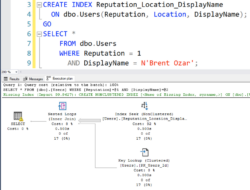
When you see “index seek” on an execution plan, that doesn’t mean SQL Server is jumping to exactly the row you’re looking for. It only means that SQL Server is seeking on the first column of the index. This is especially misleading on indexes where the first column isn’t very selective. To explain, I’ll take…
Read More
Mastering Query Tuning

5 Ways to Measure a Query

Execution Plans
2 Comments
In my free How to Think Like the Engine class, we start out by measuring query performance using logical reads. That’s the number of 8KB data pages that SQL Server has to read in order to find your query’s results. That’s the measure I use the most because generally speaking, the less data your server…
Read More

What Is a Cost-Based Optimizer?

Execution Plans
0
When you execute a query, the database server has to figure out things like: Which table to process first Which index to use on that table Whether to seek on that index or scan it Which table to process next How to join the data between those two tables When to sort the data For…
Read More