
SQL ConstantCare® Population Report: Winter 2026
It’s time for our quarterly update of our SQL ConstantCare® population report, showing how quickly (or slowly) folks adopt new versions of SQL Server. In short, people are replacing SQL Server 2016 and 2017 with 2022!
- SQL Server 2025: 0% (but it’s 10 servers)
- SQL Server 2022: 29%, up from 25% last quarter
- SQL Server 2019: 43%, no change
- SQL Server 2017: 9%, was 10%
- SQL Server 2016: 10%, was 13%
- SQL Server 2014 & prior: 6%, no change
- Azure SQL DB and Managed Instances: 2%, no change
So, is SQL Server 2022 looking better after all, like it’s going to take the throne from 2019? To understand, let’s jump back to 2023, when I wrote:
SQL Server 2017 is now the version that time forgot: folks are just skipping past that version, standardizing their new builds on 2019 rather than 2017. There wasn’t anything wrong with 2017, per se, but it just came out too quickly after 2016. These days, if you’re going to do a new build, I can’t think of a good reason to use 2017.
SQL Server 2017’s adoption rate had peaked at 24% in 2020, about 3 years after its release. Today, it’s 3 years after 2022’s release, and SQL Server 2022’s adoption rate looks like it’s still climbing – but it has a new competitor, 2025. I’m guessing we’ll see one more adoption rate bump for 2022, and then it’ll start falling again as 2017 did, unable to defeat the powerhouse that is SQL Server 2019.
I’ve grouped together 2014 & prior versions because they’re all unsupported, and 2016 will join them quickly in July when it goes out of extended support. (I can’t believe it’s been almost 10 years already!) Here’s how adoption is trending over time, with the most recent data at the right: 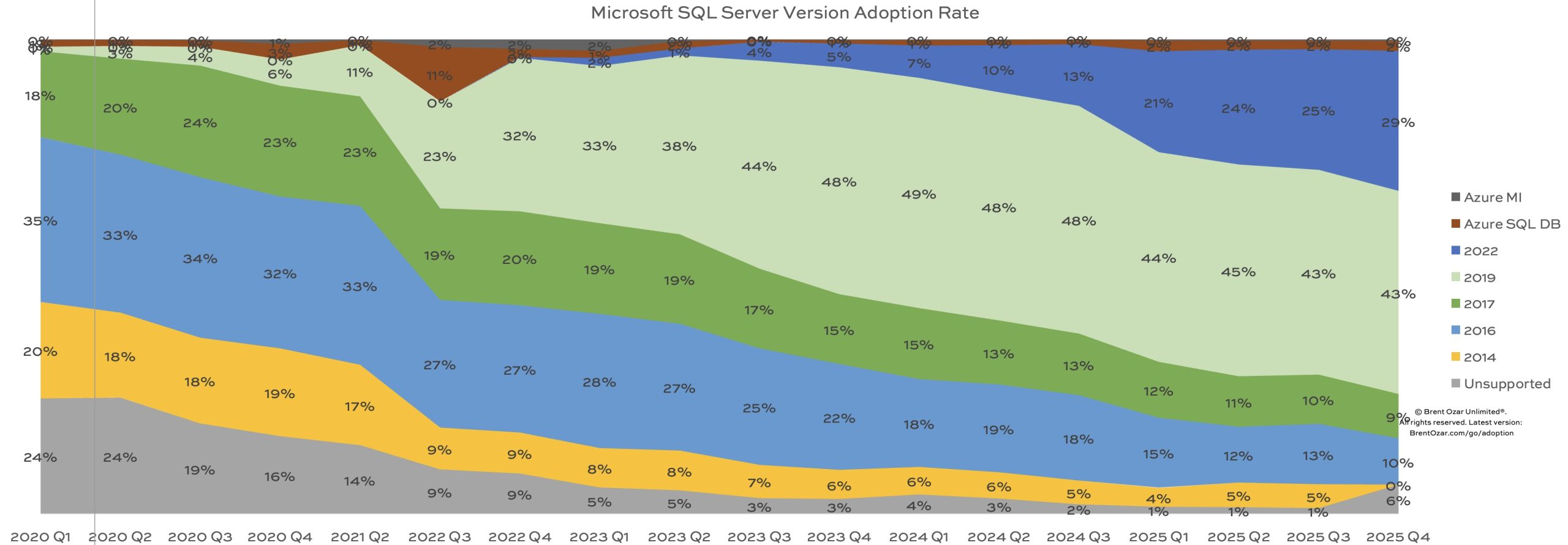
The new stuff continues its steady push from the top down, driving down the old versions out of support.

10 Comments. Leave new
Why do you think Azure SQL DB and Managed Instances are not that popular? (yet?)
I’d have thought they would be by 2026.
This because:
– you and I we work mainly with Azure SQL Database and we think that everyone else is doing the same. But it’s not
– Brent mainly works with SQL Server on-prem so most of the survey is filled up by people that work on-prem
Probably the same survey done on a website that is focused on Azure SQL Database would have bring different results
Given the absence of Web Edition in 2025, SQL Server 2022 may see some better number down the road from those running that edition.
That’s an interesting point! Right now, about 5% of the population are Web Edition.
My guess is that the 2016 and 2017 4% upgraders are naturally conservative, they see 2022 as next best stable upgrade and wouldn’t dream of looking at 2025 yet,
The mindset is “we want stability, 2022 is as stable as it’s ever going to be as they are now pushing new features into 2025”.
Would be interesting to know what proportion of 2022 systems are set to compatibility mode of an earlier version.
Yes, please! Version vs compat level would be super interesting.
What business decisions would you make based off that data?
[…] Brent Ozar has an update: […]
I’d imagine this is because of various government obstacles requiring STIG compliance in any IaaS related hosting and SQL 2022 being the latest version.
With so much hype on cloud, Fabric and also job portals advertising on sql server on cloud , only 2% are using this . This may be due to constant churning of Azure interface , deprecating old features quickly ( like AD to Entra) and high learning curve. what you do 15 days before missing on 16th day . People don’t know where to click , how to configure. It is better Microsoft keeps interface features stable fro 6 months instead of market driven rat race