
The Tech Consulting Market Isn’t Looking Good.
After hearing the same dire news from several of my consulting friends, I put a poll up on LinkedIn:
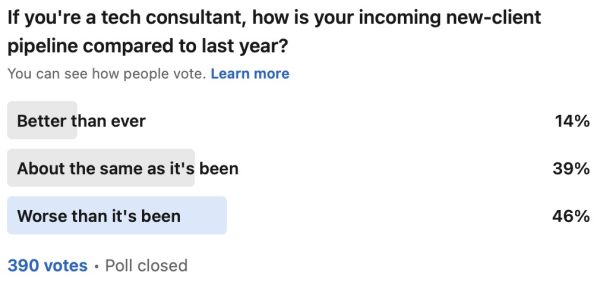
About half of the consultants out there are having a tougher time bringing in new clients than they have in the past.
There are a couple things to keep in mind about the numbers. First, some folks call themselves consultants, but they’re really long-term contractors, working for the same client full time for months (or years!) on end. If these people have long-term contracts, they may not be looking for new work, so they may not see the shift in the market yet.
Second, I purposely said “tech consultants” because I wanted to cast a wide net: people who work with any kind of technology. Of course, my peer group on LinkedIn skews towards data people and developers, though.
Finally, I didn’t quantify anything here, and it’s a really short, simple poll with just 3 choices. There aren’t options for much better or much worse, nor does it ask for any quantifying data like number of incoming leads, billable vs unbillable time, or even whether or not the consultant is even looking for new work. It’s just a quick straw poll to help y’all look around the room to see what’s going on.
In the poll’s comments and on related social media discussions, opinions were all over the place about the root causes. Some people say it’s uncertainty, others say it’s the US economy, and of course there’s the elephant in the room, AI. I’ve talked to several existing clients where managers have said, “For 2026, anytime we wanna buy something, build something, or hire someone, we’re gonna try AI first and see what happens.” Yesterday, tech company Block announced that they’re laying off about half of their 10,000 employees in order to force the rest to use AI. Block has always been cutting-edge, and I wouldn’t be surprised if many other big companies – and not just tech ones – follow suit.

February 2026 feels like March 2020.
We know something’s going on, and there’s a lot of fear, uncertainty, and doubt about what the implications are.
Back in March 2020, I remember sitting in Iceland, getting ready to go home because the US State Department told us to, and I was thinking, “Well, business is going to shut down for 6-12 months, so I guess I’m gonna be on the bench for a while.” I actually put serious thought into deciding which tool I was going to learn next because I’d have so much free time. As it turned out, the uncertainty cleared pretty rapidly, and in 2020-2022, most of us in tech worked more (and harder) than we ever had before, helping companies deal with chaotic change. Will 2026-2027 go the same way? It’s too early to tell.
This post doesn’t offer precision or analysis. I just wanted to give y’all a place to chat about it, and to know that you’re not alone. It’s certainly happened to me too – my new consulting pipeline almost shut off starting in December, although it hasn’t really affected me yet because I’d long planned to mostly be on vacation Dec-Feb, and then work on training material for SQL Server 2025 & SQLBits when I returned to the office in March. I’m keeping an eye on incoming leads, though, because it’s wild how quickly it shut down.